Content Credentials - engineering & operator guide
The engineering companion to Content Credentials identity (the user-facing page). This covers the device/CA architecture, the engine contracts, the CA service, the web-shell wiring, the one-time operator setup, the threat model, and the roadmap.
Versioning. CA-issued signing first landed at engine 1.11. The capability
bridge is additive-only, so everything here still holds, but the verifier has
grown since: it now reads both C2PA 1.x and 2.x claims (so credentials from
Gemini, Adobe, and other generators verify), Lolly writes 2.x by default, and
the trust list bundles the public C2PA/CAI anchors alongside the Lolly root. Read
the live
ENGINE_VERSIONinengine/src/version.tsand its changelog inengine/CHANGELOG.mdratherthan trusting a pinned number here. Source line numbers are deliberately omitted
below - grep the named symbol; offsets drift.
Architecture
┌───────────── device (open source) ─────────────┐   ┌─ serverless function ─┐
│ WebCrypto P-256 keypair (non-extractable, IDB) │   │ /api/ca/* function     │
│ shells/web/src/bridge/identity.ts              │──▶│ services/ca/handler    │
│   enroll: popup OIDC → PoP → cert (cached)     │◀──│  - OIDC verify         │
│   signer(): {sign, chain} while cert valid     │   │  - PoP verify          │
│ export path: embedC2pa(..., {signer})          │   │  - X.509 issue (ES256) │
│ verify path: verifyC2pa(..., {trustAnchors})   │   │ CA key: env/KMS only   │
└────────────────────────────────────────────────┘   └────────────────────────┘
Deliberately NOT a bridge capability. Tools never touch identity - enrollment is app-level (profile UI) and the signer is consumed inside the shell's own export implementation. HostV1 is unchanged; no tool can observe or depend on enrollment. The engine additions are ordinary options (opts.signer, opts.trustAnchors) on existing pure functions.
Engine contracts
HostV1 is untouched; nothing here is a bridge capability. The relevant modules:
engine/src/x509.ts (DER/X.509 authority)
Pure module shared by the ephemeral path, the CA service, and tests. No DOM, globalThis.crypto only. It owns the DER writer helpers (der, derSeq, derSet, derOctet, derUint, derOid, derTime, ecdsaRawToDer) and generateSigner (c2pa.ts re-imports them - byte-identical output, so the existing c2pa test suite is the regression harness), plus:
export function pemToDer(pem)                      // -> Uint8Array
export function derToPem(der, label)               // 'CERTIFICATE' | 'PRIVATE KEY'
export async function generateCaRoot({ commonName, organization, days })
  // -> { certDer, pkcs8Der }  self-signed CA:TRUE root, ES256 P-256, keyCertSign
export async function issueLeafCert({
  caCertDer, caPrivateKey,                          // issuer (CryptoKey or pkcs8 Uint8Array)
  spkiDer,                                          // subject public key (CSR-less PoP flow)
  email, commonName, organization,                  // SAN rfc822Name + CN + O
  days,                                             // enrollment default 30
})  // -> Uint8Array cert DER
c2pa-rs compatibility is non-negotiable in the leaf profile (it hard-fails otherwise): subject MUST carry an O= attribute, EKU MUST be id-kp-emailProtection (1.3.6.1.5.5.7.3.4 - anyEKU is rejected), keyUsage digitalSignature critical, SKI + AKI present, plus SAN rfc822Name = the verified email. Serial: random with the ephemeral path's stable-width trick.
engine/src/c2pa.ts
embedC2pa(bytes, format, opts) and embedC2paInPdf(bytes, opts) take one optional signer. buildC2paManifest already threads it; the embedders use opts.signer ?? await generateSigner(dates):
opts.signer = {
  privateKey,                        // CryptoKey (P-256, 'sign') - the normal device path
  // OR sign: async (sigStructureBytes) => Uint8Array(64)  // raw r||s, NOT DER
  certDer,                           // leaf DER (back-compat single-cert shape)
  chain,                             // Uint8Array[] leaf-first - wins over certDer in x5chain
}
Inside the COSE signing step: the x5chain (label 33) becomes signer.chain ?? [signer.certDer], and the sign call becomes signer.sign ? await signer.sign(sigStructure) : subtle.sign(…, signer.privateKey, sigStructure). Two-pass safety: chain bytes are captured once per embed (byte-identical across passes), ES256 signatures are fixed 64 bytes, alg stays hardcoded −7 - P-256 only by contract. sign() runs several times per embed (probe + fixed-point rounds + pass 2), fine for a WebCrypto key; a future user-presence key would need dummy probe signatures.
engine/src/c2pa-verify.ts
verifyC2pa(bytes, { trustAnchors } = {}) // trustAnchors: Uint8Array[] (root cert DER)Zero-options behaviour stays byte-identical (contract tests guard it). With anchors it captures the full x5chain and verifies leaf-signed-by-anchor (issuer-name DER bytes match anchor subject bytes + a signature check over the leaf's tbsCertificate using the anchor SPKI). parseCertificate is extended additively (tbsBytes, rawSignature, issuer/subject bytes, SAN emails, signature algorithm) - existing fields unchanged. It reads both c2pa.claim and c2pa.claim.v2 (with created_assertions/gathered_assertions and c2pa.actions.v2), and multi-algorithm chains (ECDSA P-256/384/521, RSA PKCS#1 v1.5, RSA-PSS, Ed25519) walk an arbitrary but bounded depth to a pinned anchor.
Report verdict semantics (surfaced by the /verify view):
- Chain verifies + leaf inside validity →
report.trusted = trueand
report.signer.identity = { email, issuer }. The view resolves this to Verified (or Delivered by Lolly when the active claim is a c2pa.published rather than c2pa.created action).
- Chain verifies but leaf outside validity → the
expiredverdict; the identity
is still set (it was CA-verified), but report.trusted stays false.
- Intact Lolly claim →
report.madeWithLolly(Made with Lolly); an intact
claim whose bytes fail only the hard binding → report.likelyMadeWithLolly (amber Likely made with Lolly).
- No anchors / no chain to an anchor → anonymous-but-valid ("Credential intact").
CLI
lolly validate <file> [--json] [--trust-anchor <root.pem>] - same verifier, same report; the flag loads PEM → DER and passes trustAnchors.
Beyond C2PA: pixel- and byte-level verify reads
The web /verify view runs several checks around the credential. Each is a pure, DOM-free engine (or shell-lib) module fed a decoded RGBA buffer or the raw file bytes by the shell; none is a bridge capability, and none uploads anything - SEAL's DNS key lookup and the deep-scan model download are the only network touches, both shell-side, and neither sends the file.
Each read has its own surface in the view, and the component library lists them against the module that defines them:
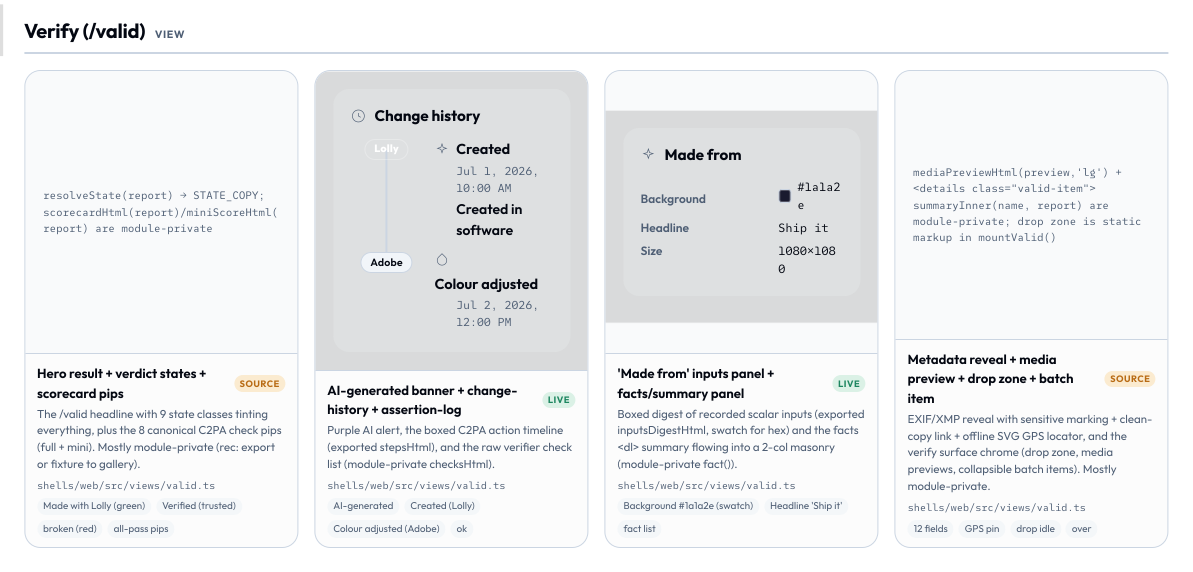
engine/src/pixel-watermark.ts - the Lolly Imprint
Block-DCT spread-spectrum watermark (Cox/Kilian/Leighton/Shamoon) on the same 8×8 grid JPEG's own DCT uses, so it survives recompression. embedWatermark(rgba, opts) adds a fixed ±1 chip to mid-band luma coefficients scaled by a perceptual mask; detectWatermark(rgba, {width, height}) correlates and returns a presence score (DetectResult); canCarryWatermark(w, h) gates images too small to hold the mark (MIN_IMPRINT_BLOCKS). Presence-only, no payload. Security posture is obscurity, not a hardened defence - the chip key ships in this public source, so a motivated adversary who reads it can subtract the mark. It's honest cover against casual re-encoding/stripping, framed exactly like the self-signed on-device C2PA key (plans/lollys-own-synth.md). The shell embeds it two ways: the standalone raster encoders' opts.imprint branch, and imprintEmbedCanvas baking the mark into each Lolly-rendered raster as it's composited into a PDF page / PPTX slide - so a pure-vector page marks nothing, and the C2PA claim is gated on whether a mark was actually applied, never over-claimed. On by default; ?imprint=0 opts out.
engine/src/steganalysis.ts - LSB chi-square
analyzeLsb(rgba, {width, height}) runs a chi-square test on pixel-pair LSB statistics and returns a likelihood that the image hides LSB-embedded data. It's a heuristic (amber), never a cryptographic verdict; the view renders it as an LSB steganography likely pip plus an LSB analysis metadata row.
engine/src/file-metadata.ts - appended payloads
extractFileMetadata(bytes) reads EXIF/XMP/IPTC and, for provenance, detects bytes appended after a container's real end (PNG IEND, JPEG EOI, GIF trailer, APNG), returning them as an appended field the view renders with view/download of the extracted bytes (rendered only as escaped hex/text - never parsed or executed). The legitimate motion-photo append (kind: 'video (motion photo)') is recognised and shown without a warning. This read is bytes-only, so MCP surfaces it in its metadata output too (it lacks the interactive extractor, but sees the same appended field).
engine/src/seal.ts - SEAL cryptographic signatures
verifySeal(bytes, resolveKey?) parses a hackerfactor SEAL record and verifies its signature over the covered byte ranges; the shell's shells/web/src/lib/seal-dns.ts supplies the resolveKey that fetches the public key from DNS. This is a byte-signature format - not a pixel watermark, and NOT Meta's Content Seal despite the shared word. A key resolved from DNS yields domain attribution (Signed by <domain> (SEAL), proving domain control, not a CA-verified legal identity); a key the file itself carries but that DNS can't confirm yields an internally-consistent-but-unattributed result. The only network touch is the DNS lookup - the file never leaves the device.
Deep scan: trustmark.ts + contentseal.ts (web, opt-in)
Two open pixel-watermark decoders behind a one-time consent - a ~90 MB detector download gated by a single batch-level banner, after which the scan is passive per file (shells/web/src/lib/trustmark.ts and contentseal.ts, with engine/src/contentseal.ts for the DOM-free decode math):
- Adobe TrustMark - a real, ECC-verified decode; a payload that passes its
error-correction check is a genuine read (green pip + recovered bytes), not a guess.
- Meta Content Seal - the open Pixel Seal / Video Seal watermark. No ECC gate,
so a decode that stays consistent across several re-encodings is an amber statistical "likely", and the note always carries the caveat that Meta's proprietary Muse image variant is a different watermark this cannot read (so a hit is never "Meta AI", and absence rules nothing out).
Everything is on-device; nothing but the one-time model bytes is fetched.
TrustMark's write side is one switch in the export panel, off by default for the same reason its scan is opt-in: a neural pass plus that one-time model download. It sits inside the Content protection card shown further down this page.
Trust anchors
Trusted verification is live - the pinned Lolly root ships as a real PEM in shells/web/src/ca-root.ts (CA_ROOT_PEM, public by design) and is also served at /api/ca/root.pem. The verifier additionally bundles the public C2PA/CAI trust anchors (engine/src/c2pa-trust.ts) so third-party credentials (camera makers, Adobe, Google's C2PA root, Truepic-signed OpenAI output, …) resolve to their real issuer. Presence in a list never trusts on its own - a verdict of trusted requires the chain to actually verify and no other check to fail.
CA service (services/ca/)
Zero-dependency Node (node:http + WebCrypto), importing engine/src/x509.ts. A workspace package. Runs three ways from one handler.mjs:
node services/ca/server.mjs- local dev on:8787(Vite proxies
/api/ca → http://localhost:8787; the string-shorthand proxy preserves the path, so the handler always routes on the full /api/ca/* prefix).
api/ca/[...path].jsat the repo root - a serverless function entry that
imports the same handler. (This bundle is generated by scripts/build-ca-fn.ts; CI rebuilds it and fails on drift - never hand-edit it.) The service worker bypasses /api/, and the platform serves functions before rewrites, so the SPA catch-all never swallows it.
- Imported directly by
tests/ca-service.test.ts(pure logic tested without
a socket).
Protocol
| Route | Purpose | ||
|---|---|---|---|
GET /api/ca/root.pem | The public Lolly root - for c2patool --trust_anchors and humans | ||
GET /api/ca/auth/:provider?origin= | Start OIDC (suse \ | github \ | google); sets HMAC state cookie, redirects to provider |
GET /api/ca/callback/:provider | Code exchange → verified email → mints a 10-min enrollment token; returns a tiny page that postMessages the token to origin and closes | ||
POST /api/ca/email/start {email} | Magic link via Resend; the link lands on /api/ca/email/verify which finishes like a callback | ||
POST /api/ca/enroll {token, spki, pop, days?} | Verify token HMAC+expiry, verify PoP (ECDSA over the token bytes with the presented SPKI), issue a leaf valid for days ∈ {7, 30, 90, 365} (anything else → CA_CERT_DAYS, capped at CA_CERT_MAX_DAYS) → {cert, chain, identity, notAfter} (PEM) |
Notes:
- CSR-less enrollment. The client sends its raw SPKI plus a
proof-of-possession signature over the enrollment token instead of a PKCS#10 CSR - same soundness, no ASN.1 CSR parser server-side.
- Stateless. Enrollment tokens are HMAC-signed values (email, provider,
exp) - no session store. Replay within the 10-minute window re-issues a cert for the same identity+key, which is harmless.
- Issuance log. Every issued cert is logged (JSON to stdout → the
platform's logs; optional CA_LOG_WEBHOOK POST). A public append-only transparency log is the Tier-3 upgrade.
- Dev provider. With
CA_DEV_FAKE_PROVIDER=1(never set in prod), a
dev provider authenticates instantly as dev@example.com so the full enroll→sign→verify loop is testable with zero OAuth secrets.
Environment variables (set in the host's environment store → also .env for local)
| Var | What |
|---|---|
CA_ROOT_KEY_PEM | PKCS8 PEM of the root private key (the only secret that matters) |
CA_ROOT_CERT_PEM | PEM of the root cert (public, also committed) |
CA_SERVICE_SECRET | Random 32+ bytes; HMAC for state cookies + enrollment tokens |
CA_CERT_DAYS | Default leaf lifetime in days when the client doesn't choose (default 30) |
CA_CERT_MAX_DAYS | Hard cap on any requested lifetime (default 365) |
CA_ALLOWED_ORIGINS | Comma list, e.g. https://lolly.tools,http://localhost:5173 |
GITHUB_CLIENT_ID / GITHUB_CLIENT_SECRET | GitHub OAuth app |
GOOGLE_CLIENT_ID / GOOGLE_CLIENT_SECRET | Google OAuth client (web) |
SUSE_ISSUER | https://id.suse.com (Okta OIDC discovery) |
SUSE_CLIENT_ID / SUSE_CLIENT_SECRET | id.suse.com OIDC app |
RESEND_API_KEY / EMAIL_FROM | Email magic links |
CA_DEV_FAKE_PROVIDER | 1 only in local dev |
Web shell
Everything below surfaces as one card in the export panel: the C2PA switch (plus its ephemeral lifetime picker), the pixel Imprint, and the opt-in durable mark, each gated per format by the predicates in views/tool-actions.ts.
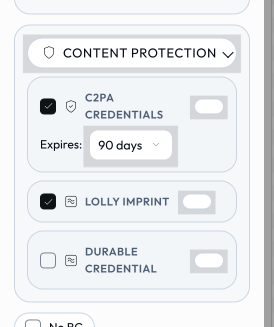
shells/web/src/bridge/identity.ts- the identity manager:
status(), enroll(provider) (popup + postMessage + PoP + cert cache), signer() (null unless a valid cert is cached), forget(). Keypair and cert live in a dedicated IndexedDB store; CryptoKey objects structured-clone into IDB natively.
- Export path passes
signerintoembedC2pa*when available - one line at
the existing call site; ephemeral fallback is the engine default.
/profilegains a Content Credentials section: enrollment status
("Signing as andy@… via GitHub - renews Jul 10"), four provider buttons, and Forget this device.
/verifypasses the pinned root (plus the bundled public anchors) as
trustAnchors and renders the trusted state: shield goes green-with-identity, facts show the verified email + issuer.
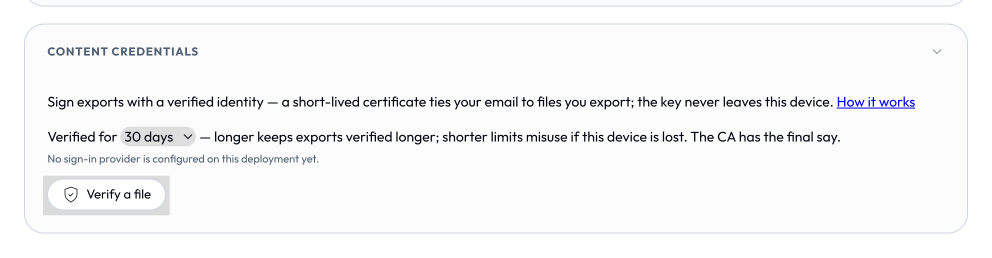
The enrolment card is where the certificate lifetime is chosen, before any popup opens. The provider buttons are built from /api/ca/health.configured, so a deployment that has wired up no OIDC app says so instead of offering a button that would 501.
Operator runbook (one-time setup - the parts only you can do)
- Generate the root (anywhere, then guard the key):
``bash node services/ca/scripts/gen-root.mjs # writes lolly-root-cert.pem + lolly-root-key.pem ``
Commit/paste lolly-root-cert.pem into shells/web/src/ca-root.ts. Never commit the key. Store it in a password manager, then set the following secrets in your platform's environment store (production scope):
`` CA_ROOT_KEY_PEM # paste the key PEM CA_ROOT_CERT_PEM CA_SERVICE_SECRET # e.g. openssl rand -hex 32 CA_ALLOWED_ORIGINS # https://lolly.tools ``
- Register OIDC apps (callback URL for all three:
https://lolly.tools/api/ca/callback/<provider>; add the http://localhost:8787/api/ca/callback/<provider> variant for dev):
- GitHub → Settings → Developer settings → OAuth Apps → New.
Scope used: user:email. Set GITHUB_CLIENT_ID/SECRET.
- Google → console.cloud.google.com → Credentials → OAuth client
(Web). Scopes: openid email. Set GOOGLE_CLIENT_ID/SECRET.
- id.suse.com (Okta) → your Okta admin → Applications → Create App
Integration → OIDC Web App. Scopes: openid email. Set SUSE_ISSUER (the issuer from the app's OIDC discovery), SUSE_CLIENT_ID/SECRET.
- Email → resend.com API key + verified sender →
RESEND_API_KEY,
EMAIL_FROM.
- Set the env vars in your platform's environment store (production
scope, and add a preview/staging copy so preview deploys can exercise it):
`` CA_ROOT_KEY_PEM # paste the key PEM CA_ROOT_CERT_PEM CA_SERVICE_SECRET # openssl rand -hex 32 CA_ALLOWED_ORIGINS # https://lolly.tools # …plus the provider creds from step 2. Do NOT set CA_DEV_FAKE_PROVIDER in prod. ``
- Deploy. The CA lives at repo-root
api/ca/[...path].js(a serverless
function) importing services/ca/ + engine/src/x509.ts; both are committed, and the platform compiles api/ independently of the Vite build. The app's catch-all rewrite "/(.)" → /index.html is an afterFiles rewrite, so /api/ca/ resolves to the function first - it is not swallowed by the SPA fallback. Confirm it's live: curl https://lolly.tools/api/ca/health should return JSON ({"ok":true,…}), not the SPA's HTML. If it returns HTML, the function wasn't compiled - check the project's root directory setting is the repo root (so repo-root api/ is in scope), not shells/web.
- Local dev (no secrets needed thanks to the dev provider):
``bash CA_DEV_FAKE_PROVIDER=1 CA_SERVICE_SECRET=dev node services/ca/server.mjs & npm run dev:web # Vite proxies /api/ca → :8787 ``
Threat model (abridged)
- Repo is public → contains no secrets; root cert is public by design.
- Device key theft → key is non-extractable; even XSS can at worst use
it while the page is open, bounded by the cert lifetime and per-identity revocation at the CA.
- CA key theft → catastrophic for trust, as with any CA; mitigations:
env-only storage now, KMS/HSM at Tier 4, short leaf lifetimes limit the blast radius of a missed revocation.
- Fork abuse → forks can request certs only through our OIDC-gated,
origin-allowlisted, rate-limitable endpoint, and only for identities they actually control.
- Token replay → 10-minute expiry + PoP binding to a specific keypair.
Roadmap
- RFC 3161 timestamp countersignature in the same enroll/export round trip
→ the expired verdict becomes provable-time trusted.
- Public append-only issuance transparency log (Rekor-shaped).
- CLI signer support (
--c2pa-cert/--c2pa-key) for CI pipelines. - C2PA conformance program: audited KMS custody → the official trust list →
green in Adobe Verify et al.
SSO - two distinct jobs, one identity provider
id.suse.com (Keycloak) shows up in two places that must not be conflated. Both reuse the same OIDC client, but they answer different questions. Detailed implementation plans (local, under plans/): plans/sso-signing.md and plans/sso-tool-access.md - the summaries below are the roadmap view.
- *Complete SUSE SSO for signing*** (deepens the identity in this doc -
"who signed"; full plan → plans/sso-signing.md). Today SUSE is one enrolment provider among several and each enrolment is a fresh popup. Bring it to true SSO:
- Session reuse / silent renewal. While the id.suse.com session is
live, a cert nearing expiry re-issues in the background via OIDC prompt=none - no weekly popup, no interaction. This is what makes short (7-day) certs painless and is the natural companion to Tier 3 timestamps.
- Org / domain enforcement. Optional issuance policy
(CA_REQUIRE_ISSUER=suse, CA_ALLOWED_EMAIL_DOMAINS=suse.com) so a SUSE deployment mints certs only for SUSE identities, and SUSE becomes the default IdP (other providers opt-in).
- Richer provenance identity. Carry the SSO group / role / org-unit into
the certificate (an OU or SAN otherName) so a credential can attest "signed by a SUSE employee," not just an email - gated on the realm releasing those claims. Feeds the CreativeWork author assertion.
- *SSO for tool access*** (a NEW authorization axis - "who may use the
app," separate from signing; full plan → plans/sso-tool-access.md). Gate who can open the app, specific tools, or gated features behind SUSE SSO:
- Shell-level auth guard, never the engine. The engine stays
platform-agnostic; access control is a host/shell concern. The web shell gains an auth gate in front of the gallery/tool routes, configurable as fully-gated, or per-tool / per-capability (a tool.json access policy the host enforces, mirroring how capabilities gate today).
- One IdP, two purposes. Reuse the same id.suse.com/Keycloak OIDC the CA
uses, so a signed-in user is already enrol-ready for signing; sign-in for access and identity for signing share a session.
- Session handling. A lightweight
/api/auth/companion to/api/ca/
on the same serverless deployment (httpOnly session cookie, PKCE, refresh), with role/group-based tool visibility.
- OSS-safe by default. Access-gating is deployment policy: off in the
open-source build so public lolly.tools stays open, enabled only by configuration so a SUSE-internal deployment can lock it down. Keep it out of engine/ and behind a shell config flag so the open-sourcing split stays clean.