Security & Verification
A security reviewer's summary of the cryptography behind Lolly's Content Credentials, verification, and encryption — the standards it implements, the primitives it uses, how trust is earned, and how all of it is tested. This is the public companion to the deeper Content Credentials — Engineering guide; the operator narrative lives in Lolly for Operators.
The short version: verification is entirely on-device, the crypto is standards-based and built on the platform's own WebCrypto engine, and every claim is backed by a test — known-answer vectors, adversarial forgery/replay tests, fuzzing, and conformance against independent tools.
Verification is on-device
Everything Lolly verifies, it verifies locally, offline, without uploading the file. Dropping a file on /verify (or lolly validate <file>) parses it, walks its Content Credential, re-checks the signature and the byte-hash binding, and renders a verdict — all in your browser or on your machine. There is no verification server.
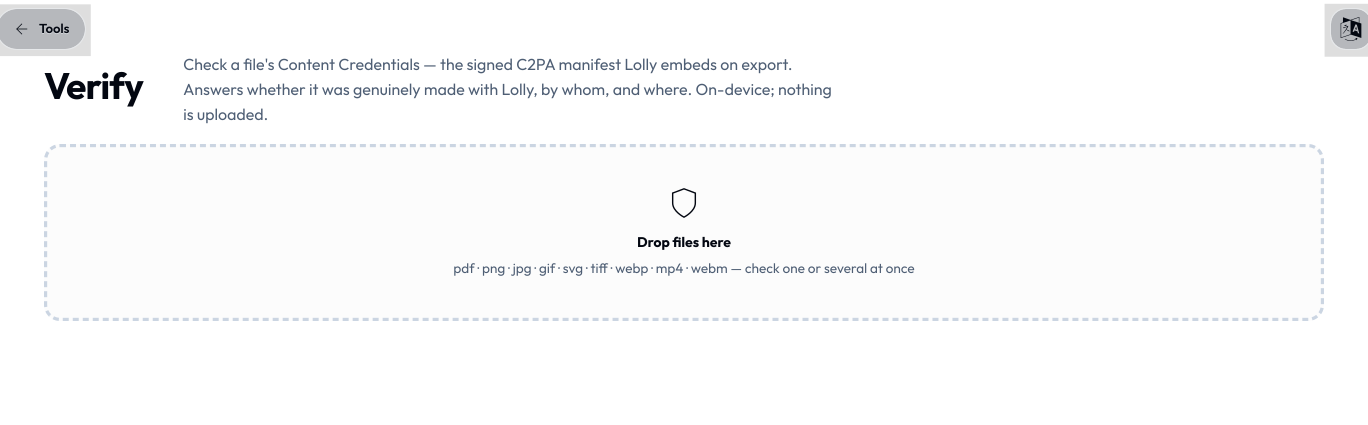
The engine's crypto core is platform-agnostic and uses only globalThis.crypto / WebCrypto — no bespoke crypto library, no Node-only APIs, and no network calls anywhere in the engine. The single network-capable path in the whole verification surface is an optional DNS-over-HTTPS lookup of a SEAL signer's public key — and even that never sends the file, only fetches a public key the shell (not the engine) requests.
Standards implemented
| Area | Standard |
|---|---|
| Content Credentials | C2PA 2.x (reads v1 + v2 manifests from any producer) |
| Signing certificates | RFC 5280 (X.509/PKIX), C2PA cert profile §14.5.1 |
| Signature container | RFC 9052 / 9360 (COSE_Sign1) |
| Serialization | RFC 8949 (deterministic CBOR) |
| Key fingerprinting | RFC 7638 (JWK thumbprint) |
| Credential boxing | ISO 19566-5 (JUMBF) |
| Video binding | ISO 14496-12 (BMFF) |
| PDF encryption | ISO 32000-2 §7.6.4 (PDF 2.0 AES-256, R6) |
| Zip encryption | PKWARE APPNOTE + WinZip AE-2 |
| Byte-level signatures | SEAL (verification) |
| Durable soft binding | Adobe TrustMark (read) |
| Supply chain | CycloneDX 1.5 (SBOM) |
Cryptographic primitives
- Signing (Content Credentials, catalog integrity, issued certificates): ECDSA P-256 / ES256 with SHA-256. The on-device signing key is generated per session and is non-extractable — even Lolly can't read it.
- Verifying (to accept the whole C2PA ecosystem): ECDSA P-256/384/521, RSA PKCS#1 v1.5, RSA-PSS, and Ed25519.
- Encryption: AES-256 for the Strong PDF lock (PDF 2.0 / R6) and Strong locked downloads (WinZip AE-2), with PBKDF2 key derivation and HMAC authentication. Standard tiers (40-bit RC4 for PDF, ZipCrypto for zip) are deliberately labelled as quick, universal deterrents — reach for Strong for anything sensitive.
- Hashing: SHA-256 throughout (SHA-384/512 where a curve or algorithm requires it).
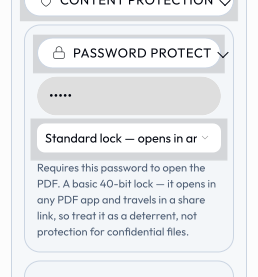
All of the above run on the platform's audited WebCrypto implementation. The two symmetric ciphers use a small in-house block layer only because WebCrypto exposes no raw AES block — this is used encrypt-only, over your own content, never as a decryption oracle.
How "trusted" is earned
Lolly reports the trust a file can actually prove, in explicit tiers:
valid— the credential is structurally intact and the byte-hash binding holds: the file is unaltered since signing. An un-enrolled export isvalidbut signed anonymously (untrusted) — that's the default, and it's honest.trusted— additionally, the signer's certificate chain cryptographically reaches a pinned trust anchor and the claim signature verifies under that signer's key and nothing else failed. Both conditions together are what make a copied ("replayed") signer certificate worthless to an attacker: it can't produce a claim signature that verifies under the real owner's non-extractable key.
Trust anchors are public certificates only — the C2PA ecosystem roots (Google, Adobe, the CAI trust list, camera makers, AI providers) plus Lolly's own public root. Presence on the list never confers trust by itself — trust always requires the live chain walk and signature check above. Chain walking is bounded (a capped number of intermediates, parsed defensively) so a hostile certificate chain can't exhaust resources.
There is no timestamp authority yet, so an authentic-but-expired signature surfaces the signer's identity while staying trusted: false — it proves who, not when. An RFC 3161 timestamp countersignature is on the roadmap.
Complementary provenance signals
Beyond the C2PA credential, Verify surfaces several read-only signals — each an honest heuristic that only ever adds confidence, never a false alarm:
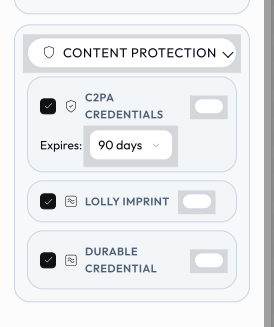
- The Lolly Imprint — an invisible pixel watermark, on by default, that survives a screenshot or re-save (where the credential dies to any container change). Presence-only, no personal data. It is security-through-obscurity — casual-stripping cover, not a hardened defence — and complements the credential rather than replacing it.
- SEAL byte-level signatures, AI-generated-content declarations, third-party pixel-watermark deep scans (opt-in, one-time on-device model download), and hidden-data detection — all computed locally.
Lolly's provenance strategy is read-broad, embed-narrow: it reads many signals but only ever writes C2PA (plus its own Imprint), which keeps the write-side attack surface small. That narrow write side is visible in the export panel: three named switches, each a separate mechanism, rather than one blanket "protect this" claim.
How it's assured
Every cryptographic claim above is backed by an automated test in the repository (npm test):
- Known-answer tests (KATs). Byte-for-byte fixed vectors: the CBOR encoder, the PDF R6 encryption vector, the zip CRC/AE-2 output, and the canonical-JSON signing form are each pinned to an exact expected byte string, so an accidental change is caught immediately.
- Adversarial tests. Signer-replay, lifted-signature, forged-intermediate, and identity-impersonation attempts are all asserted to resolve to untrusted; tampering any covered byte (inside the manifest, the claim, an assertion, or the file body) is asserted to break the correct check.
- Fuzzing. Hostile, truncated, and deeply-nested inputs are run through the C2PA, CBOR, and X.509 parsers with a regression corpus, asserting they fail closed — no crash, no runaway recursion or allocation.
- Independent conformance. Lolly's output is validated by the reference tools it interoperates with — c2patool (C2PA), qpdf (PDF), and Adobe's own reference implementation for TrustMark — and Lolly's verifier is proven against a manifest signed by an entirely independent producer, not just its own round-trip.
- Supply chain. A full CycloneDX SBOM is generated deterministically and drift-checked in CI, and
npm auditblocks any high- or critical-severity dependency advisory from landing.
The cryptography and parsers are additionally undergoing SUSE's enterprise-scale security hardening. They are strong by design today; where a contract calls for certified assurance, deploy Lolly as one layer of defence-in-depth.
Design boundaries (worth having straight)
- *Content Credentials are tamper-evident, not tamper-proof.* They detect alteration cryptographically and offline; they don't prevent it. That is exactly what makes fully offline verification possible.
- The on-device signer is anonymous by design unless you enrol a verified identity. No real credential ever leaves the device.
- Tool hooks are not a security sandbox. A tool's optional
hooks.jsruns with the host bridge injected but, in a browser shell, executes in the page's realm. Run only tools you've reviewed until Worker isolation ships — an org running a shared catalog can gate it through Git review. - Interoperability: WebM has no standardised C2PA mapping yet, so Lolly attaches the manifest as a Matroska part (its own verifier reads it; MP4 verifies in third-party tools out of the box).
Where to go next
- Content Credentials — Engineering — the engine contracts, trust anchors, CA service, and threat model in full.
- Content Credentials Identity — how verified-identity enrolment and the Lolly CA work.
- Lolly for Operators — provenance, encryption, and air-gap deployment in context.
- Privacy Policy — the formal "collects nothing, uploads nothing" statement.