Lolly Inclusive Design Policy
Last updated: 30 July 2026
Our ethos. An open source community includes all of us. Software that anyone can read, run and change only earns that openness when anyone can actually use it - whatever they see, hear, process, speak or believe. So we treat accommodation as a form of celebration, never a compromise: a preference that makes Lolly calmer, louder, larger or more familiar for someone is not a degraded mode of the product. It is the product, meeting one more of us where they are.
What this policy covers
Lolly is a creative tool: people come here to make things that represent them. That shapes every accommodation below in one specific way - adjusting the app never adjusts your work. Accessibility preferences restyle Lolly's own interface: menus, cards, navigation, type. They are engineered never to reach inside the tool canvas or the export pipeline, and automated tests fail our builds if a preference could move a single pixel of an exported file. You should never have to choose between a comfortable app and a faithful render.
Accessibility
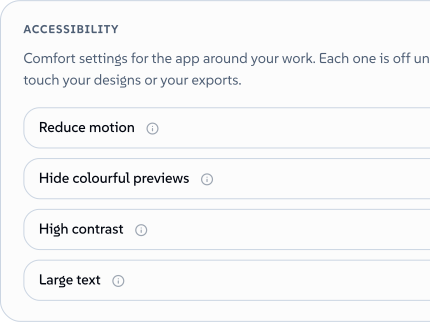
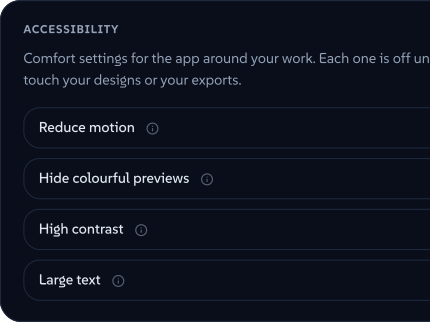
Beyond following the platform's own signals (system dark mode, the OS reduced-motion preference), Lolly ships explicit, opt-in accessibility preferences on your profile:
- Reduce motion turns off transitions, slides and animated flourishes in the app, and combines with (never overrides) your operating system's setting. Animated exports keep moving exactly as designed.
- High contrast strengthens borders, text and focus rings around your work. Your brand colours and canvas stay exactly as you set them.
- Large text grows the app's type and icon glyphs without reflowing your designs, so what you export is byte-identical.
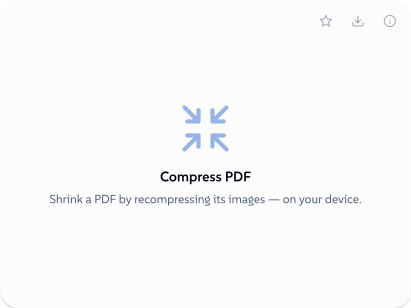
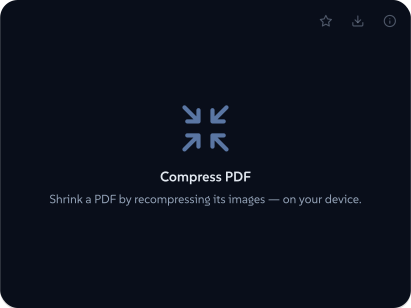
- Hide colourful previews swaps the gallery's preview artwork for calm icon and text cards, and softens project thumbnails, halving their colour and contrast, so they stay recognisable without the colour noise. Full colour returns the moment you step inside a tool, so the one place high-stimulus imagery appears is the one place you chose to work on it.
 signerad av Lollyvektor SVGKontrollera självHämta den signerade filen15 paths~4.2k nodes29 groups84 KB
 signerad av Lollyvektor SVGKontrollera självHämta den signerade filen15 paths~4.2k nodes29 groups84 KB


Alongside the preferences: controls carry accessible names and pressed states, changes are announced to screen readers, overlays close on Escape, keyboard focus is visible and strengthened further under high contrast, and every one of these switches is a plain, always-visible card on the profile page - findable by someone who can barely read the page as it is, which is the moment it matters.
Listen. Every page of this documentation can be read aloud - play, pause, and follow the words as they are spoken, at a pace you set. Slowing down costs nothing in quality: it is a different speed, not a lesser one, for anyone who learns at their own pace.
Reduced and enhanced stimulation
Neurodivergent people are not one audience with one need. The same brain that is overwhelmed by a wall of colourful thumbnails on a hard day may seek strong sensory input on another, so Lolly accommodates in both directions, always opt-in:
- Turning it down. Reduce motion and Hide colourful previews strip the interface back to icons, text and one accent colour. Navigation stays busy-free for people with ADHD, autistic people and dyslexic people who find dense, high-variance imagery hard to scan; nothing you need (favourites, pinning, actions) is taken away in the calmer presentation.
- Turning it up. Neurospicy Mode is a deliberate sensory layer - focus loops, an atmosphere mixer with individually levelled ambient beds, procedural music and interface sound effects - for people who focus best with rich input. It is off by default and never auto-plays before you ask.
- Sound is separable. Every audible layer has its own switch, so "visuals calm, sound rich" and the reverse are both real configurations, not a single accessibility bundle someone else composed for you.
 signerad av Lollyvektor SVGKontrollera självHämta den signerade filen11 paths~1.5k nodes17 groups33 KB
 signerad av Lollyvektor SVGKontrollera självHämta den signerade filen11 paths~1.5k nodes17 groups33 KB


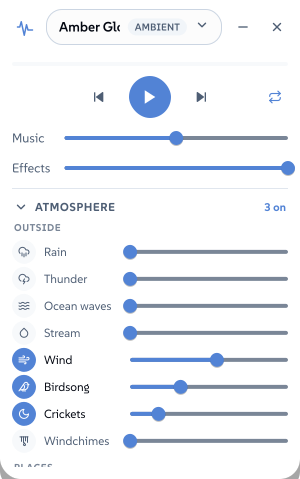 signerad av Lollyvektor SVGKontrollera självHämta den signerade filen54 paths~2.8k nodes120 groups63 KB
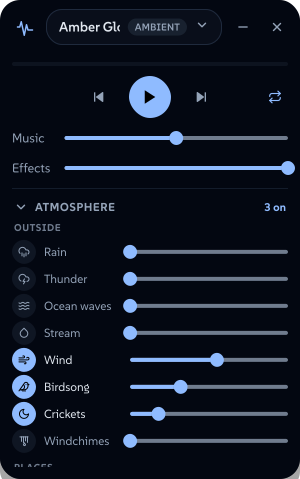 signerad av Lollyvektor SVGKontrollera självHämta den signerade filen54 paths~2.8k nodes120 groups63 KB


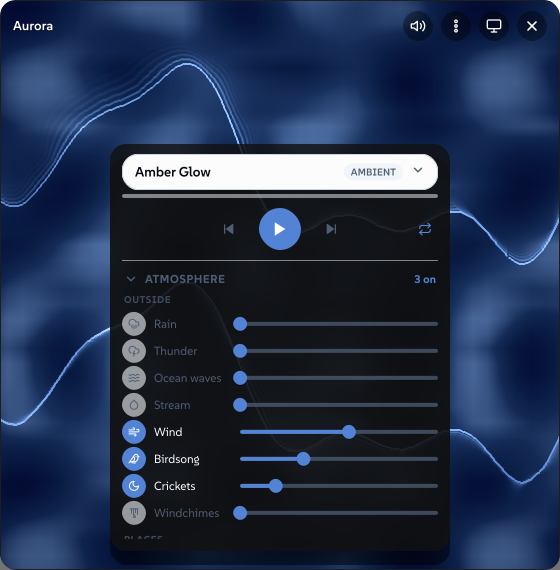 signerad av Lollyvektor SVGKontrollera självHämta den signerade filen56 paths~2.8k nodes115 groups1 image518 KB
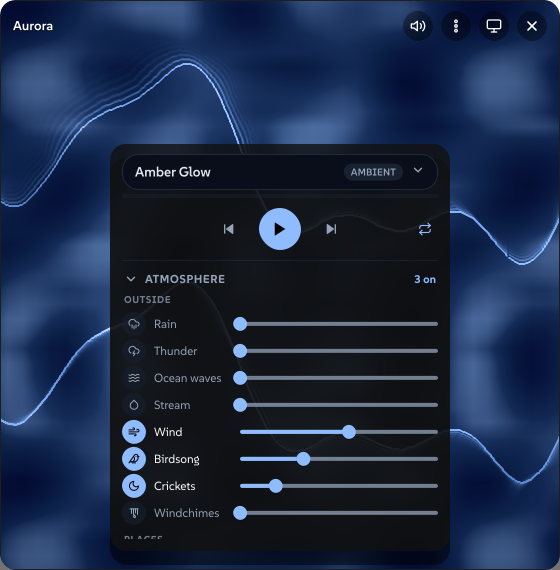 signerad av Lollyvektor SVGKontrollera självHämta den signerade filen56 paths~2.8k nodes115 groups1 image518 KB


Language and localization priority
- Lolly's interface and documentation are translated into more than 25 languages, and we prioritise languages by how many people speak them, not by market revenue - Hindi, Bengali, Urdu and Indonesian arrived in the same waves as French and German.
- Right-to-left scripts are first-class: Arabic ships with full RTL layout, not a mirrored afterthought.
- Languages are distinct, not interchangeable: Indonesian and Malay are separate catalogs, Traditional and Simplified Chinese are separate catalogs, and the language attribute is set before first paint so Han characters and script fallbacks render correctly for your language, not a lookalike.
- The language menu lists every language in its own name and script, and can be ordered by speaker population, so finding yours never requires knowing its English name.
 signerad av Lollyvektor SVGKontrollera självHämta den signerade filen9 paths156 nodes19 groups11 KB
 signerad av Lollyvektor SVGKontrollera självHämta den signerade filen9 paths156 nodes19 groups11 KB


Cultural inclusion
- The neutral starting brand assumes nothing about who you are; Lolly exists so your own identity, palette and type replace ours in minutes.
- Type is treated as a cultural surface: uploaded and Google fonts are shaped with proper text shaping across scripts, so names, diacritics and non-Latin text export as correctly drawn outlines rather than tofu or substitutions.
- Copy avoids idioms and culture-bound references that translate poorly, and translators receive clean, bare strings rather than sentences with markup fragments baked in.
Why this produces better work, not just kinder software
Accessibility gets filed under compliance, which quietly frames it as a cost. It is not one. The same properties that make a tool usable on a hard day make it faster on every other day, and they compound.
- Cognitive endurance is the real budget. Attention is finite and it drains unevenly. Every dialog you dismiss, every setting that resets, every choice a template should have made for you spends a little of what you had left for the work. Constraint-first tools spend almost none of it: the brand decisions were made once, at the tool, so producing the twentieth asset costs what the first did. People who need that most feel it first, and everyone benefits from it.
- Creative confidence comes from a floor you cannot fall through. When any output could be wrong in a way you will only discover later, you check everything twice and stay cautious. When off-brand output is not reachable, the checking stops being your job and the caution goes back into the work. Confidence is not a mood here, it is a property of the constraints.
- Right compounds. A decision encoded in a tool is correct every time that tool runs, in every language, at every size, for everyone who uses it. A decision written in some style guidelines doc is only influential correct as often as it is read. With no promise of correct output to the reader. The difference is small on one asset and enormous across a year.
- What protects the workflow protects the person. On-device rendering, plain-file exports and offline capability are usually filed under privacy, and they are also what keeps you working on a bad connection, on a locked-down machine, or the day a subscription lapses. Your workflow does not have dependencies you did not choose.
Two things follow that we treat as inseparable: operational superiority, because software that respects your attention and your data is simply faster to work in, and ethics that cannot be traded away, because they are architectural rather than promised. A policy can be revised under pressure. An engine that never receives your content has nothing to revise.
Ethical commitments
- Privacy by architecture. Your work stays on your device. There are no trackers or analytics in the codebase, and the few network touchpoints are enumerated in the Privacy Policy. Accessibility and language preferences are stored in your own profile, on your device - a person's disability or language is never telemetry. Telemetry is no friend of this project: we don't want it, and nobody should have to give their data away.
- Honest provenance. Exports can carry Content Credentials, and AI-generated content is labelled as such. We believe audiences deserve to know how media was made, and creators deserve tools that can prove their work is theirs.
- No dark patterns. Preferences are plain switches that do what they say, defaults are dormant until you choose them, and platform conventions (native scrolling, browser shortcuts, standard dialogs) are respected rather than hijacked.
- Open source. The engine, shells and community tools are public. Every claim in this document is checkable in the source, and several are enforced by tests that fail the build when broken - the additive-by-default rule for accessibility attributes, the ban on preferences reaching exports, and the keeping-in-step of the app's two copies of each preference.
Holding ourselves to it
Inclusive design here is a policy in the engineering sense: invariants with tests, not aspirations with adjectives. When an accommodation and a feature conflict, we redesign the feature (when a 'hide previews' setting also hid icons off utility cards, the fix was to keep the actions, not to excuse the loss). If something in Lolly excludes you - a missing language, an overwhelming moment, an assumption we baked in without noticing - that is a bug. Tell us: fitzy@suse.com.