How Lolly compares
Where this platform fits in the wider creative-tools landscape, and where it deliberately does not play.
Pilot status: Lolly is a closed-pilot prototype, not a finished product, and its security is currently undergoing SUSE's strict infrastructure hardening, preparing for enterprise scale. This positioning is where Lolly aims to sit - the Adoption & Governance page covers how that's being tested in practice.
Landscape
| Capability | Canva (Open canvas) | Brand portals (DAM templating) | Illustrator (Desktop pro) | Figma / Penpot (Online pro) | Lolly (Constraints-first) |
|---|---|---|---|---|---|
| Mass content generation | partial | ✗ | ✗ | ✗ | ✓ |
| Works fully offline | ✗ | ✗ | ✓ | partial | ✓ |
| Template logic & hard constraints | ✗ | partial | ✗ | partial | ✓ |
| No design skill required | partial | ✓ | ✗ | ✗ | ✓ |
| Automatic Content Credentials | ✗ | ✗ | partial | ✗ | ✓ |
| Tools compose other tools | ✗ | ✗ | ✗ | ✗ | ✓ |
| Open engine, not SaaS-locked | ✗ | ✗ | ✗ | partial | ✓ |
| C2PA content credentials | ✗ | ✗ | ✗ | ✗ | ✓ |
| Opt-in forensic-level provenance | ✗ | ✗ | ✗ | ✗ | ✓ |
| Mobile and Desktop Apps | ✓ | ✗ | ✗ | partial | ✓ |
| Command Line & TUI | ✗ | ✗ | ✗ | ✗ | ✓ |
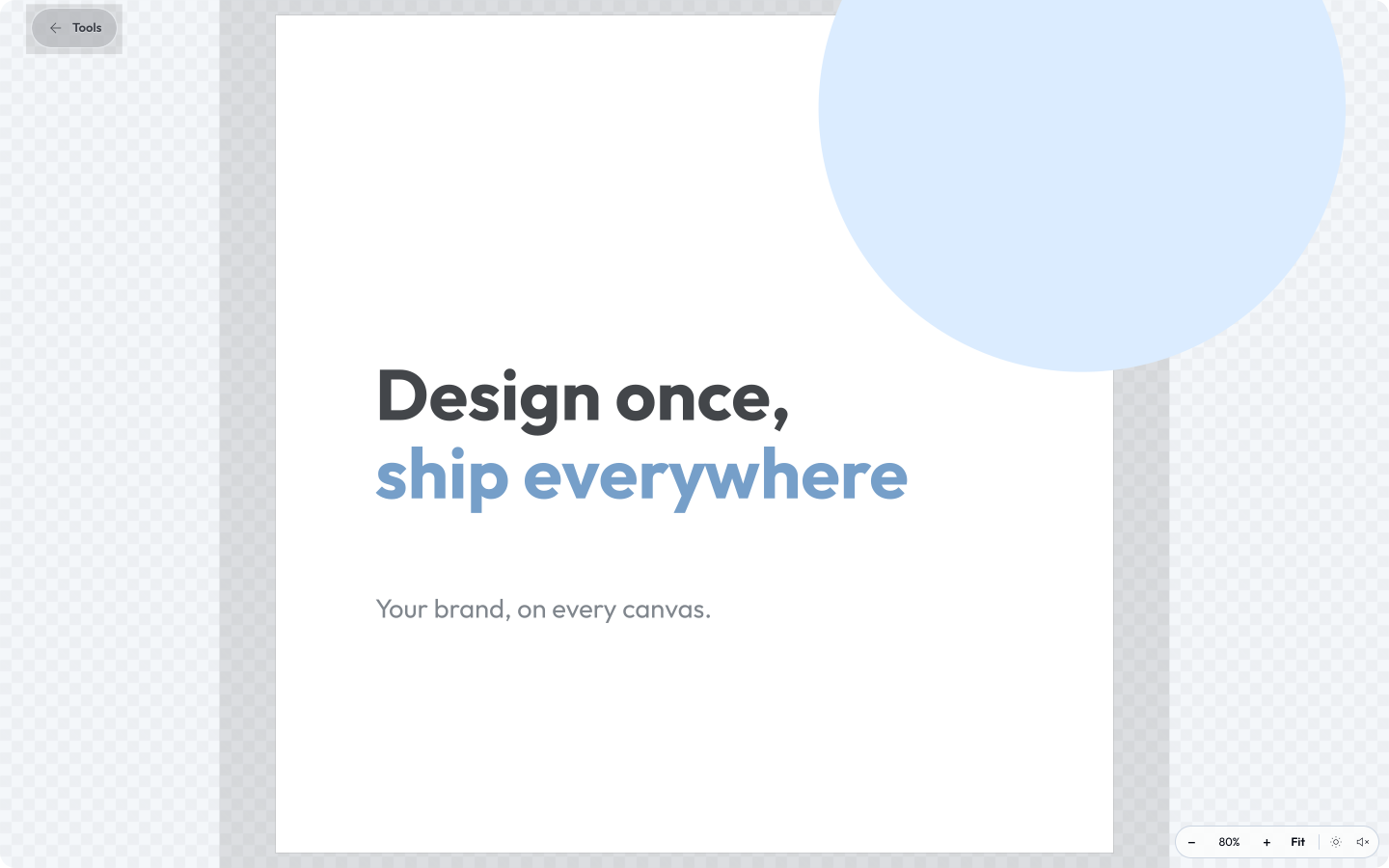
The shape of the gap is clear: nothing in the existing landscape gives us constraints-first, offline-capable, low-skill, internally accessible, generative output. Lolly now ships an open canvas of its own - Layout Studio, a direct-manipulation free canvas - but with a decisive difference from the Canva column: colours, type and assets placed on it conform to the brand globals, so even free arrangement stays constraints-first. What Lolly still is not is an unconstrained design suite; designers will continue to use Illustrator and Figma for bespoke work - and when that work needs to become a governed, reproducible asset, Layout Studio's Import a design brings the finished Figma/Illustrator/Penpot file onto the canvas as editable, brand-conformed boxes.
Use it for
- Rapid generation of operationalised creative assets (event tiles, badges, signatures, alerts)
- Free-form arrangement on the open canvas (Layout Studio) when the pieces - colours, type, icons, images - must stay conformed to the brand globals
- Landing a finished Figma, Illustrator, InDesign or Penpot design (Layout Studio's Import a design) so it can be edited, governed and re-rendered deterministically in every Lolly format
- One-to-many "fill in three fields, get the finished asset" flows - including bulk runs from a spreadsheet/CSV in the
/probatch grid (paste or import rows, one finished asset per row, download as a zip) - Always-on, recurring branded outputs
- Things where central control of brand expression matters more than expressive flexibility
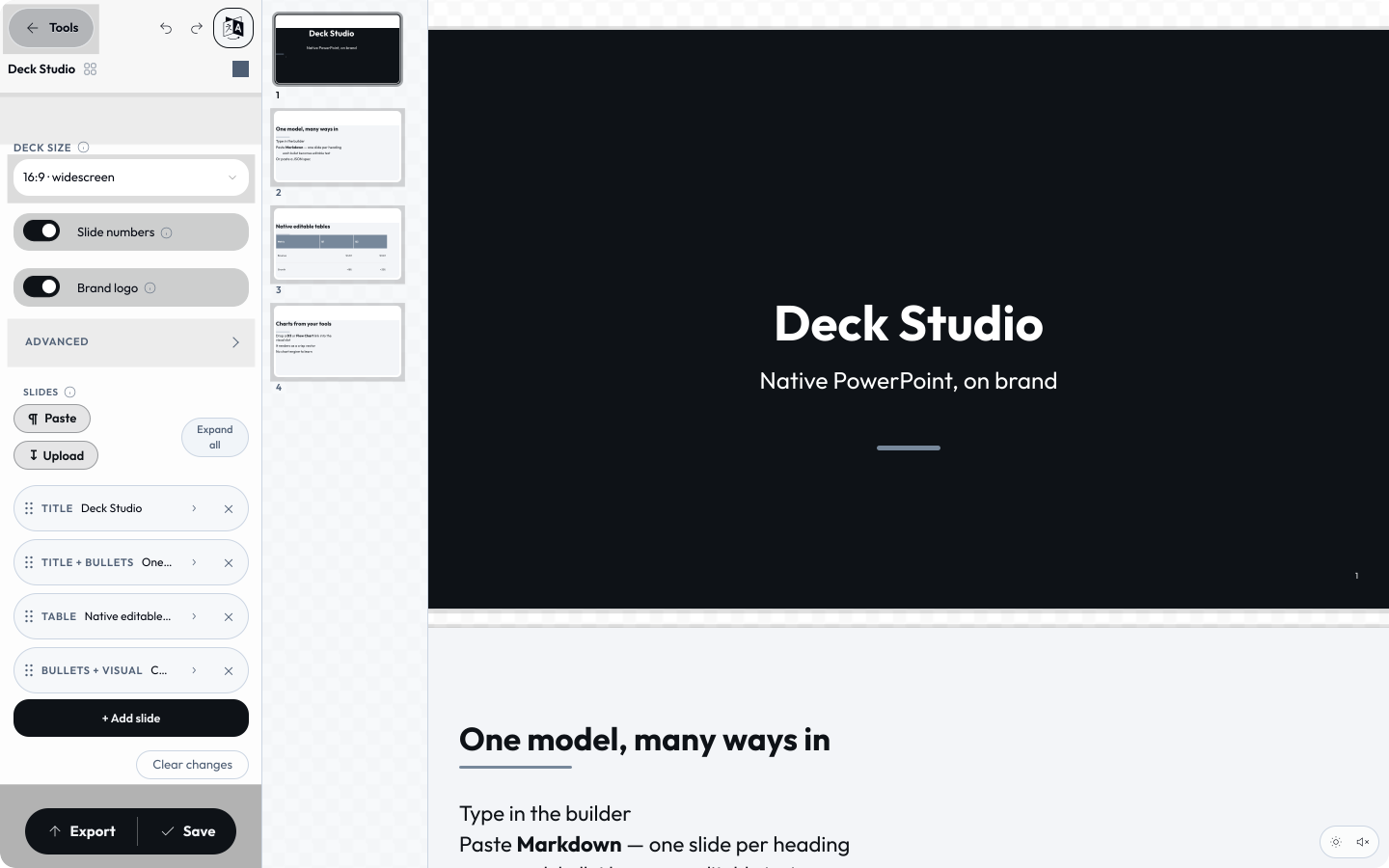
Deck Studio is a good measure of the ceiling here: a whole slide deck declared as data, laid out live on the canvas, and exported as a native editable PowerPoint.
Do not use it for
- Bespoke or flagship hero content (billboards, major videos)
- Unique campaign work that genuinely needs a designer
- Ideation that needs to escape the brand system entirely - Lolly's open canvas still conforms colours, type and assets to the brand globals, and that's the point
Innovate probabilistically, scale deterministically
Most "AI creative" pitches put the model on the wrong side of an old line. Scribes and illuminators already settled where it falls: you work loose on the sketch, where anything can be tried and nothing is committed, and then you go to the printing press, which is intimidating exactly because it commits. The sketches were where the art was. The press was how it travelled. Two instruments, two jobs, both of them inventive in their own register, and the printed work could be trusted because the press kept its promise on every pull.
Lolly is the press, not the sketch. Bring whatever you like to the ideation - a model, a designer, a napkin - but the moment an idea has to become ten thousand assets it goes through something that renders the same way every time, from inputs anyone can read back. That is what the comparison above is really about: not who has the better generator, but who makes the committed step reproducible.
Trust the creative process, scale with rigour.
Approve the tool, not the file
Every other tool in the landscape produces a file that then has to be checked - a brand manager in a Slack thread, legal on the disclaimer, a round of changes, another review. Lolly moves the approval one step upstream. The brand rules - exact hex codes, licensed font files, bleed margins, spacing - are hard-coded into the tool's HTML and CSS, so the template physically cannot emit an off-brand asset. The layout itself is load-bearing.
So you stop approving outputs and start approving the tool that makes them. Approve it once, and every asset it ever produces is pre-approved by construction - no human in the loop, no review cycle, at any volume.
This is the paradigm shift the deterministic engine actually delivers: it isn't a faster version of the old approval process, it removes the process. For the creative team it's a guard-rail, not a replacement - you still throw the ball (the data, the copy, the image) and the code is the bumper lane that keeps every throw out of the gutter.
| Approving assets the old way | Approving the tool, the Lolly way |
|---|---|
| Every finished file is checked, one at a time | The tool is checked once |
| Request → designer builds → brand review → legal check → changes → re-review | One parameter change → finished asset |
| Designer, brand manager, legal and requester all in the loop | The producer, on their own |
| Days per asset | Seconds per asset |
| 10,000 assets = 10,000 review cycles | 10,000 assets = zero (the template was already approved) |
What this uniquely provides
- Wild design potential delivered safely in context. Tools can express adventurous design ideas inside hard coded guard-rails.
- Software-defined content automation that returns the final asset. Input → final file. No "now save it from your design tool and post-process it."
- Tools compose tools. One tool can embed another tool's render and return it as part of a single finished asset, with no tool-to-tool code coupling - a primitive no open-canvas or DAM-templating product in the landscape offers.
- Vendor neutrality. Full feature and cost control. Open-source engine. Tools and assets are git-tracked content, not locked in a SaaS database.
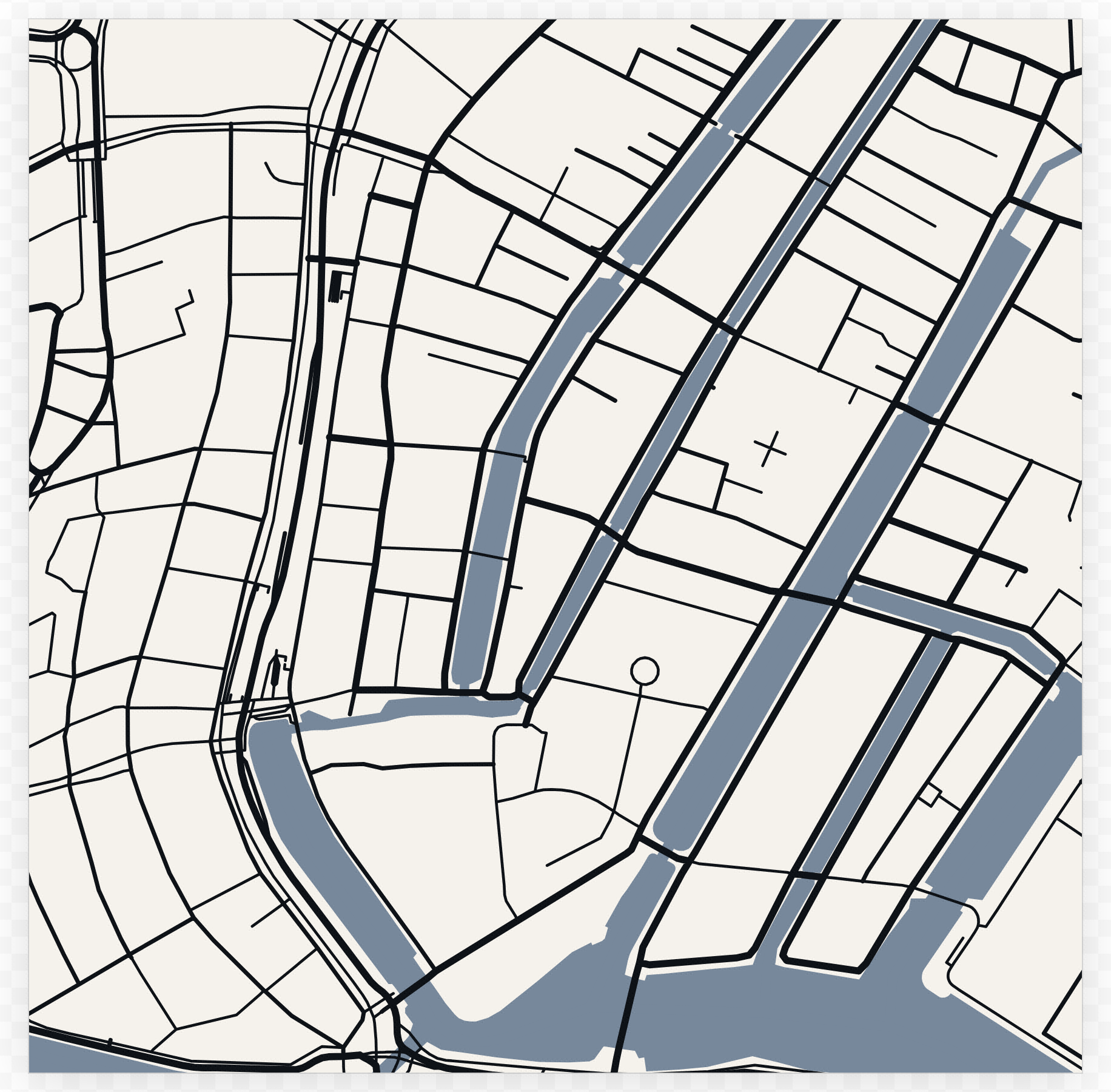
The first of those is the one people underestimate. A poster-grade city map, drawn as true vector road and water paths, from a dropdown and two colour fields that cannot be pointed outside the brand: