
This guide covers the optional organisation service. Configuration, console and API paths refer to your Work instance. The packaged console keeps its release-matched copy of this guide.
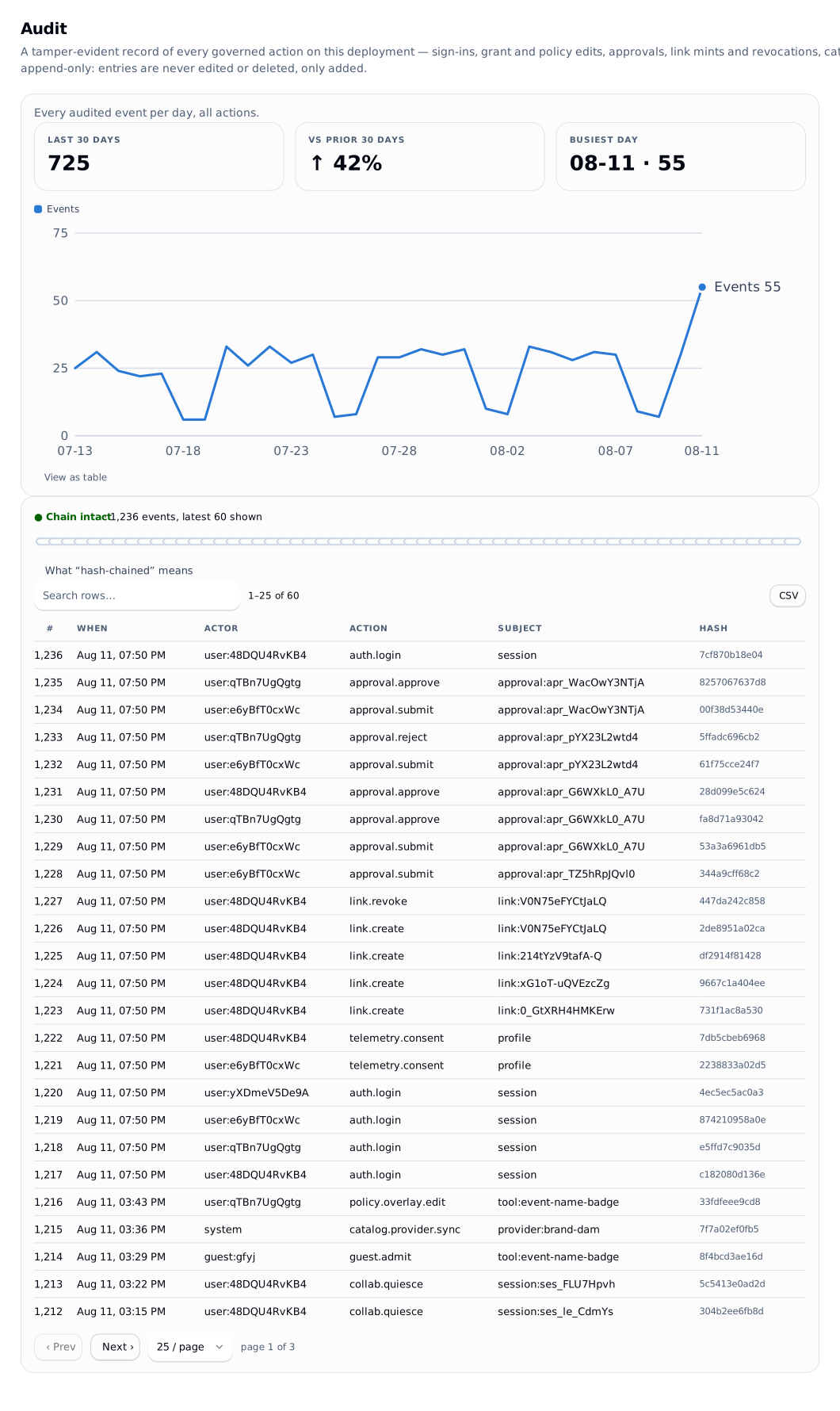
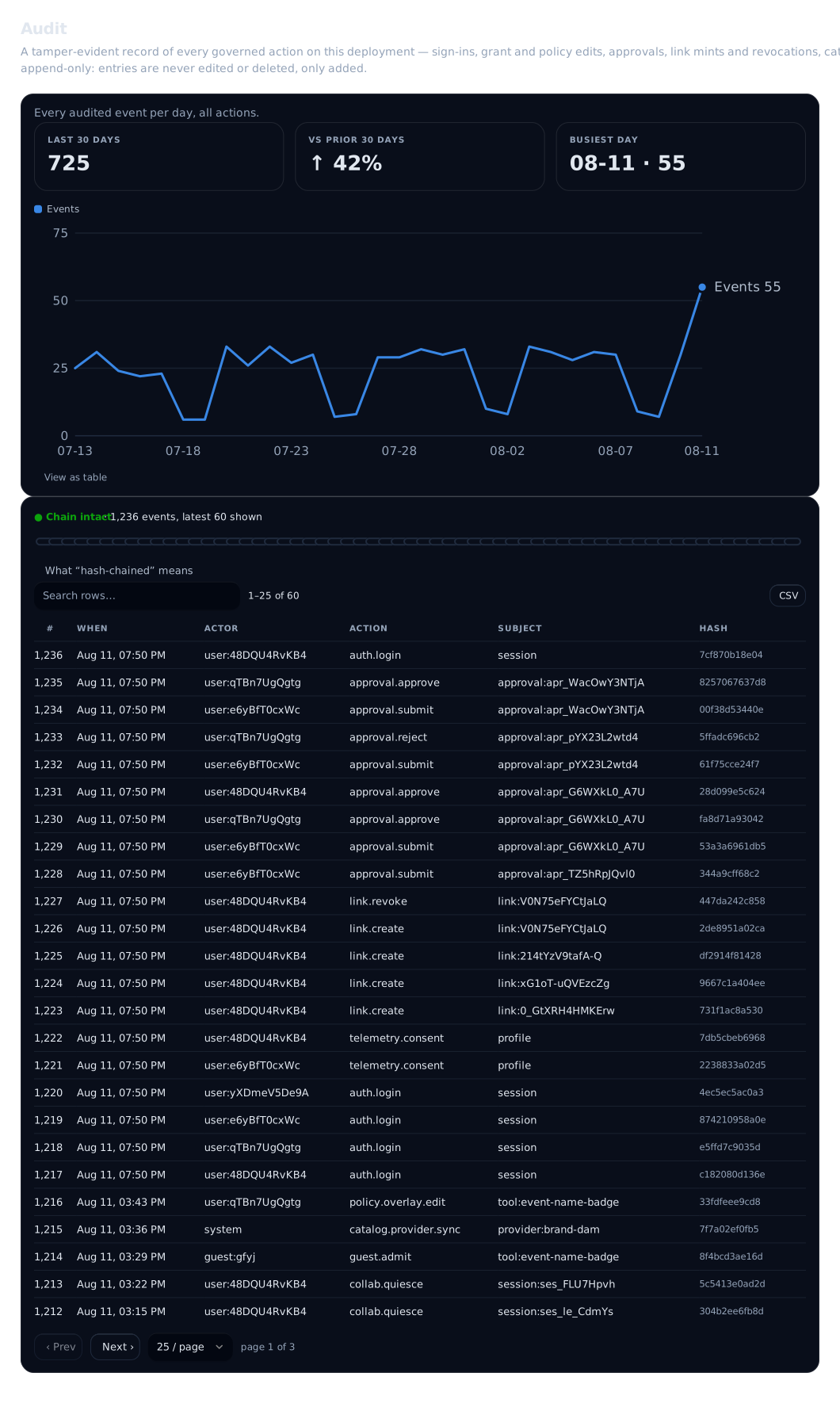
A tamper-evident, append-only record of every governed action on this deploy: sign-ins, grant and policy edits, approvals, group and lockout changes, link mints and revocations, provider changes, catalog changes, config applies.
 signed by Lolly Demovector SVGনিজেই যাচাই করুনস্বাক্ষরিত ফাইলটি নিন৬ paths৯৫ nodes২৯৩ groups১ image২৪৫ KB
 signed by Lolly Demovector SVGনিজেই যাচাই করুনস্বাক্ষরিত ফাইলটি নিন৬ paths৯৫ nodes২৯৩ groups১ image২৪৫ KB


Entries are never edited - only added, and only ever removed by stated retention: policy.retention.auditDays trims rows older than the window behind an anchor (seq + hash) that keeps the chain verifiable (operations).
How the chain works
Each event's hash covers the previous event's hash plus the canonical JSON of the event body. So an in-place edit or a truncation breaks the chain at a specific, detectable sequence number. Verification walks the chain and reports either "intact" or the first bad seq.
GET /api/v1/audit?limit=…        # entries + a chain verification result   (audit.export)
GET /api/v1/audit/head           # the current head: seq, hash, count, chainIntact
lw audit verify # exits 2 if the chain is broken
lw audit head # prints seq · hash · count · intactThe console's Audit view shows the same chain with its verification state, and the lw_audit_chain_intact Prometheus gauge (1/0) is the thing to alert on.
Payloads must already be privacy-safe when they are written - digests and field names, never raw input values. The chain module does not inspect them; the call sites are responsible, and policy edits record before/after shapes.
What holds the database itself to account
Two things beyond the chain. Every row also carries a keyed MAC: an HMAC of its hash under a key derived at boot from LW_SESSION_SECRET, which the database never holds. A database holder who edits a row and recomputes the public chain from there on still cannot produce MACs that verify, and every verification path (/api/v1/audit, the head, the Prometheus gauge, lw audit verify) checks them. Rows written before the key existed have no MAC; verification counts them as unkeyed rather than failing them, but only at the start of the log. Every host installs the key before it writes, so once a row has a MAC, every later row must have one too: a row without one after that point is a stripped MAC and breaks the chain. The console's badge shows the unkeyed count when there are any. Rows signed under a session secret that has since been rotated are covered by a retired-key boundary (below). On Postgres, migration 0034 adds a trigger that refuses UPDATE and DELETE on audit_log; the retention trim is the one delete it admits, and it announces itself inside its own transaction after writing the anchor.
Rotating the session secret
The MAC key is derived from LW_SESSION_SECRET, so a new value means a new key. Every row written before the rotation stops verifying, and the chain reads as broken at the first of them. Which way out depends on whether you still have the old value:
- The old value is known. Deploy the new value with
LW_SESSION_SECRET_PREVIOUSset to the old one (operations), so sign-ins carry over. The audit MAC uses the current key only, so also runretire-key(below) while PREVIOUS is still set: it first checks every row it is about to retire against the previous value, and refuses if a row verifies under neither. - The old value is gone, for example because the platform stores secrets write-only. Nothing can check the old MACs again. Record the head first, while a server still runs the old value, and run
retire-keyonce every host that writes to this database runs the new one.
Before you rotate: record the head
While the server still runs the old value, record the seq and public hash of the last row, and whether every row verifies under that value:
lw audit head --json                                              # through the API
docker compose exec -T server node scripts/audit-head.ts --json   # in the server container
scripts/audit-head.ts reads the database directly and never writes. Besides the head it prints linksIntact (the hash links alone, no key). Keep the seq and hash: after the rotation, retire-key --expect-head <seq>:<hash> refuses unless that row still has that hash, and the hash links pin every row before it, so nothing up to the head can be rewritten between the rotation and the boundary. deploy/vm/rotate-secrets.sh records the head itself and prints the command with it filled in.
Recording the boundary
Once every host runs the new value, sign in once: the server writes that sign-in under the new key, and the command needs one such row (below). Then:
lw audit retire-key --reason "secret rotation 2026-10-04" --expect-head 412:9f2c… --dry-run
lw audit retire-key --reason "secret rotation 2026-10-04" --expect-head 412:9f2c…
# in the server container (the image carries scripts/, not cli/):
docker compose exec -T server node scripts/audit-retire-key.ts --reason "secret rotation 2026-10-04" --expect-head 412:9f2c…
It talks to the database directly and needs DATABASE_URL and LW_SESSION_SECRET, which the server's environment has. It appends one row, action audit.key.retire, MAC'd under the current key. Its payload records retiredThroughSeq and retiredHeadHash (the seq and hash of the row directly before it), the reason, how many rows it retires, whether they were checked against a previous value, and the head it was given (expectedHead). Keep the reason to why ("secret rotation"), not who. The row is appended only while the log still ends at the row it names, so two runs at once write one boundary, not two.
Before it writes, it checks that the rows since the last boundary look like a key change and nothing else. Otherwise it refuses, writes nothing and exits 2:
broken: a hash link is broken. That is an edit or a deletion.head-mismatch: the row given with--expect-headis gone or has another hash.stripped: a row has no MAC although an earlier row has one.interleaved: a row that verifies under the current key comes before one that does not. A key change leaves the old-key rows first and the current-key rows after them, so this means an edit re-chained from there on, or a host still writing with the old value. If it is the second (a deployment that was switched last), switch it, then run again with--allow-interleaved.no-witness: no row after the old ones verifies under the key the command was given, so nothing shows the server runs that key. Sign in once and run again. This is what stops a run with the wrongLW_SESSION_SECRET, whose boundary the server would ignore.--no-witnessskips the witness check.previous-mismatch: withLW_SESSION_SECRET_PREVIOUSset, a row verifies under neither value. If PREVIOUS holds an older value that this rotation did not replace, run without it (in a container:docker compose exec -e LW_SESSION_SECRET_PREVIOUS= server …).
The two overrides are recorded on the boundary (allowInterleaved, noWitness). From then on, verification:
- counts a row before the boundary whose MAC fails under the current key as a retired-key row instead of failing it;
- still checks every hash link through those rows. The boundary's MAC covers the hash it records, so an edit before the boundary breaks the chain exactly as before;
- ignores a boundary whose MAC does not verify or that does not name the row directly before it, so a database holder without the secret cannot write one;
- requires every row after the boundary to verify under the current key, and fails a row without a MAC after the first row that has one.
The chain then reads as intact, and says why. The head log line becomes intact=true (412 rows signed with a retired key before 2026-10-04T09:12:00.000Z); GET /api/v1/audit/head and the chain of GET /api/v1/audit add retiredKeyRows, retiredThroughSeq and retiredBefore (present only when there are such rows); the console's badge and lw audit head show the same note. A later rotation works the same way: the newest valid boundary covers every row before it, older boundaries included.
The command writes nothing when the chain already verifies under the current key. Exit codes: 0 for a boundary written or nothing to retire, 1 for a usage or environment problem, 2 for a refusal or a chain that still fails after the boundary.
What it cannot do: without the old value, nothing can tell a row written under the old secret from one a database holder rewrote and re-chained, as long as the server writes again after the rewrite and before the command runs. --expect-head closes that for every row up to the recorded head. The rows after it (written by hosts still on the old value before they were switched; the dry run counts them) rest on their hash links alone. So record the head, switch every host promptly, run retire-key straight after, and never run it to clear a broken chain that a rotation did not cause.
The one limitation, stated plainly
Hash-chaining and the MAC detect edits within the log. They do not, by themselves, stop someone with superuser access from dropping the trigger and truncating the newest entries: rows that never existed leave nothing to verify.
The defence is to record the head hash somewhere outside this deploy. A later chain that does not contain the head you saved is provably truncated.
The server prints the head by default. Every instance emits it at boot and then hourly; external collection and retention are an operator responsibility:
[lolly-work] audit head seq=… hash=… count=… intact=…Ship those lines to an independently retained log service with controlled deletion access, and verify receipt and retention there. Local journald, a local file or kubectl logs alone can disappear with the host or deployment and do not establish an external anchor. The timer is unref'd, so it never holds the process open. The defaults are
"audit": { "headLog": { "onBoot": true, "intervalMinutes": 60 } }and { "onBoot": false, "intervalMinutes": 0 } turns it off - do that only if you anchor some other way, because an unanchored chain is exactly the gap this exists to close.
For a stronger anchor than log retention - one you can hand an auditor - snapshot the head somewhere append-only on your own cadence (a cron committing it, a ticket per release):
lw audit head --json > audit-head-$(date +%F).json # commit it, ticket it, ship it to a sinkReading the log
The console's Audit view and the Activity feed read the same rows for different jobs: Audit is the authoritative record with chain verification; Activity is the humane merged timeline (audit + attributed telemetry) with actor and category facets. audit.export gates the raw API.
The console filters the full retained history, before pagination, by exact actor ID, action and subject plus an inclusive UTC date range. The API accepts actor, action, subject, since, until, limit (up to 1000), and before (sequence cursor):
GET /api/v1/audit?action=approval.submit&limit=50Responses include total for the retained log, matched for the full filtered history, and nextBefore for an older matching page. Keep the filters when following that cursor. Rows within each page remain in ascending sequence order. Invalid or reversed date ranges are rejected. The chain verdict covers the complete retained chain, not the filtered rows; filtered rows alone cannot prove chain continuity. Actor filtering currently uses stored IDs rather than a broader identity-directory lookup.
Related
- What else is recorded, and what deliberately is not: telemetry
- Monitoring and alerting: operations
- Who may export: permissions