
This guide covers the optional organisation service. Configuration, console and API paths refer to your Work instance. The packaged console keeps its release-matched copy of this guide.
Frozen source review
POST /api/v1/approvals accepts subjectType: "source-review" with a sourceReview containing a non-empty purpose, explicit activation target and up to 32 exact files. Each file names assetId, integer version, format, lowercase hex sha256 and representation: "original". The initial implementation supports directly owned inst/* originals. Materialized provider files and previews require their own qualification and are refused here.
Work verifies the actual bytes and freezes the purpose, target and complete membership under one fingerprint. Request and decision origin distinguish a member session from an agent acting through delegated authority; neither is an automated-rule approval. A member cannot approve their own request; the selected chain still controls eligible reviewers. Source access is checked for every member of the frozen set at request and action. A hidden member hides the whole review, including its count. Review history additionally follows its requester/reviewer audience. No source grant is widened by a decision.
An action must echo sourceFingerprint from the displayed review. Older clients that cannot display and confirm the frozen subject are refused before a decision is recorded. The updated console supplies that fingerprint for approve/reject. The version-history response advertises sourceReviewCapability only for this supported path: at most 64 MiB per file and 128 MiB for the complete subject. Clients without that capability keep ordinary history available and do not offer a source-review request.
Replacing a file does not transfer review to its replacement. Changing the purpose, target or membership creates a different subject. Approval is historical evidence about the exact reviewed source set; catalog admission, conformance, processing authority and approval of final delivery bytes stay separate. Source attribute history remains not-recorded, even when old original bytes exist. The existing version-history response includes visible sourceReviews without claiming that the current version was reviewed. The Assets source-history form requests a review of one selected instance file; the API supports bounded sets.
Chains, not graphs. An approval chain is an ordered list of steps; each step identifies an eligible team by group and a completion rule. There is no BPM engine, no DAG, no parallel branch - the shape that matches how a Marketing → Legal review actually runs.
 signed by Lolly Demovector SVGনিজেই যাচাই করুনস্বাক্ষরিত ফাইলটি নিন৭ paths১৩২ nodes৭০ groups১৮২ KB
 signed by Lolly Demovector SVGনিজেই যাচাই করুনস্বাক্ষরিত ফাইলটি নিন৭ paths১৩২ nodes৭০ groups১৮২ KB


Chains
GET /api/v1/chains
PUT /api/v1/chains/:id        # policy.edit
{
"id": "brand-review",
"name": "Brand review",
"version": 1,
"steps": [
{ "name": "Marketing", "approvers": { "groups": ["marketing-leads"] }, "rule": "any" },
{ "name": "Legal", "approvers": { "groups": ["legal"] }, "rule": { "quorum": 2 } }
],
"onReject": "return-to-submitter"
}| Rule | Clears the step when |
|---|---|
any | one eligible approver approves |
{ quorum: n } | n distinct approvers approve |
all | every nominee named at submit has approved; with no nominees it behaves as any |
Chains bind to work in two places today: catalog submissions go through the chain policy.submit.chain names (catalog), and any other approval identifies its chainId when it is raised. The overlay key enforce.escalation is declared in the type but the overlay write paths do not accept it yet - see status.
Raising and acting
POST /api/v1/approvals              # subjectType, subjectRef, title, chainId, nominees?
GET  /api/v1/approvals              # filtered to what the caller may see
GET  /api/v1/approvals/approvers    # who is eligible for a step, for nomination
POST /api/v1/approvals/:id/act      # { action: 'approve' | 'reject', comment? }
POST /api/v1/approvals/:id/withdraw
Subjects are asset, tool-change, config or guest-link - one engine, several kinds of thing to approve.
The chain is snapshotted at submit: an approval is judged by the rules it was raised under, so editing a chain never rewrites decisions already in flight.
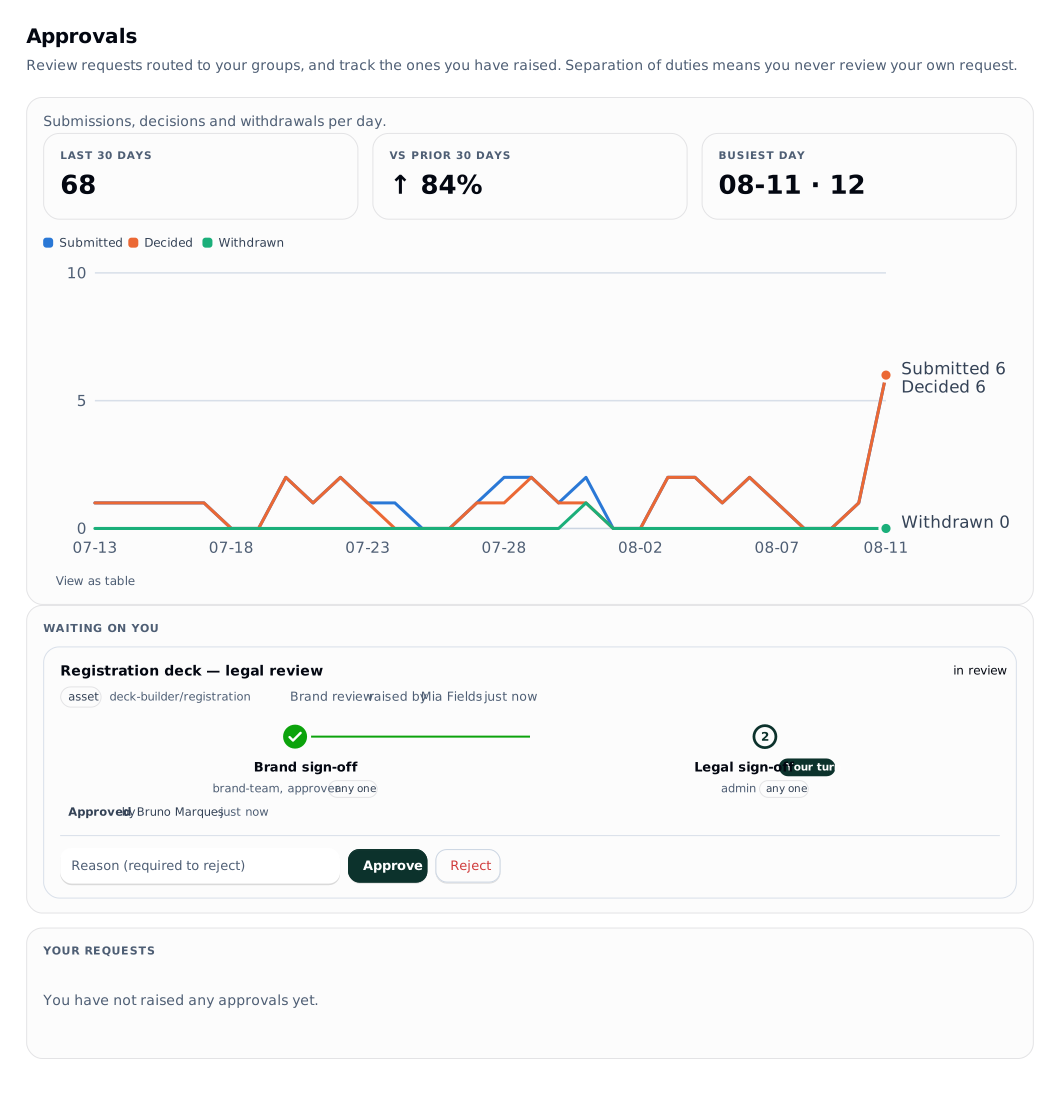
States: in_review → approved | rejected | withdrawn (a stepless chain approves at once). Acting requires approval.act and membership of the step's approver groups, subject to the separation-of-duties rules below. A custom reviewer group does not automatically receive that permission; assign the approver role or an explicit grant.
Invariants the engine enforces
These are enforced in code and covered by property tests, not merely documented:
- Separation of duties. The submitter can never satisfy a step - checked before eligibility, so they always get the specific reason (
SEPARATION_OF_DUTIES). - Eligibility by group. An actor's groups must intersect the step's approver groups (
NOT_ELIGIBLE). Nomination is routing and notification, not exclusivity: any eligible team member may act; nominees just get pinged. - No step is skippable. A step completes per its rule, then the index advances; only past the last step is the whole approval
approved. - A reject is terminal.
onReject: 'return-to-submitter'means the submitter opens a new approval - there is no resume.
Notification
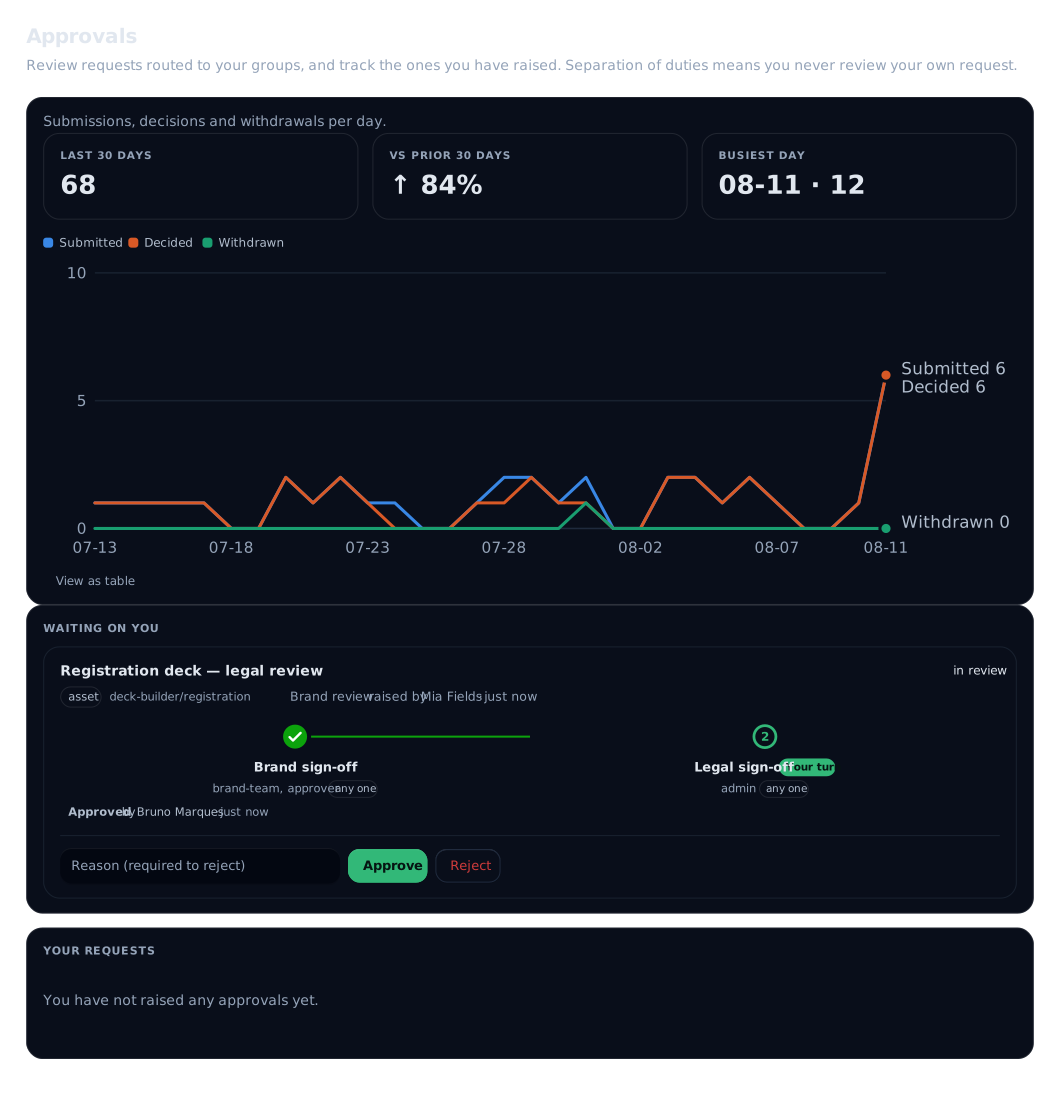
Acting on an approval writes to the per-user inbox, so the approver's next shell poll (and the console's Approvals view) shows what needs them. The console's overview surfaces "what needs me" from the same source, and messages/inbox targeting is described in api.
Watermarking preview output
The Approval chains console page edits ordered groups and any/quorum/all rules, moves steps, and previews aggregate reviewer counts. Editing requires policy.edit. Preview excludes disabled accounts, applies approval.act grants and denies, and reports counts excluding the operator because a requester cannot review their own work. It is a chain preview, not a guarantee for every subject-specific grant or later nomination. Chain saves advance the version; existing requests keep their submitted snapshot.
Both generic and catalog review actions require approval.act as well as group eligibility and separation of duties. Nomination choices, new nominations, notifications and the generic inbox also respect effective permissions. A custom reviewer group whose members have the member role needs an explicit allow grant, for example approval.act on chain:brand-review. A deny still wins. Review-chain configuration does not bind ordinary tool exports to reviewed final bytes; that export workflow remains pending.
An overlay can set enforce.watermark: 'until-approved', which is the intended pairing with a chain: previews carry the diagonal PREVIEW brick pattern while the work is unapproved. Today the compositor knows only "watermark now" vs "don't": always is enforced, the per-render until-approved linkage to approval state is deliberately not yet wired, and never is stored but behaves the same as unset. See sharing and status.
Related
- Who can approve: permissions
- Binding a chain to a tool: governance
- Exporting chains as code: governance