
This guide covers the optional organisation service. Configuration, console and API paths refer to your Work instance. The packaged console keeps its release-matched copy of this guide.
Two layers, one evaluator:
 signed by Lolly Demovector SVGControleer het zelfDownload het ondertekende bestand13 paths203 nodes96 groups2 images193 KB
 signed by Lolly Demovector SVGControleer het zelfDownload het ondertekende bestand13 paths203 nodes96 groups2 images193 KB


- A small fixed role set, derived from group membership.
- Fine-grained grants -
(principal, action, resource, effect)rows that override the role default in either direction.
Evaluation order is fixed and pure: any matching deny wins → any matching allow → the role default. server/src/rbac/evaluate.ts is the whole thing, and it never looks anything up: a resource arrives as the set of selectors it satisfies (e.g. ['tool:event-badge', 'tool:tag/external-facing', '*']).
Roles
| Role | Comes from | Carries |
|---|---|---|
viewer | service tokens only (lw tokens create --role viewer) - no group resolves a person to it | catalog.read, session.view, collab.join |
member | the default for any signed-in user | viewer + tool.use, session.create/edit/delete/share, project.create, export.download, export.request, delivery.create, link.create |
author | group author | member + catalog.submit |
approver | group approver | member + approval.act |
admin | group admin | author ∪ approver + catalog.publish, catalog.expire, catalog.hold, catalog.scan, catalog.edit, catalog.collection.manage, catalog.provider.read, catalog.provider.manage, brand.switch, catalog.injectable.manage, policy.edit, grant.edit, link.revoke, link.create-guest, message.send, telemetry.view, fleet.view, fleet.manage, audit.export, project.manage, project.archive, approval.assign, export.server, user.invite |
owner | group owner | admin + instance.config, catalog.provider.credential, catalog.provider.publish, scim.manage, token.manage |
guest | a guest-edit link | nothing - access is entirely link-scoped grants |
Role comes from the effective group set (IdP ∪ local groups): the highest of owner, admin, approver, author, else member. See identity.
Projects add a second, narrower layer: each person has a role on each project they can see (owner, manager, editor or viewer), and the project routes ask for both. Saving needs session.edit and editor on that project; renaming, sharing and inviting need manager. The roles and where they come from are in sharing. Inviting new people from a project follows policy.invites.allow rather than user.invite alone; see sharing.
Who can see who has access
A project's people list (GET /api/v1/projects/:id/members) marks each row with where the access comes from (plans/75 G15). Everyone on the project sees the owner (via: 'owner') and the explicit members (via: 'member'); only the project's managers also see the other ways in, in a separate effective list, so no client offers a role select or Remove for access the project cannot take away:
| Row | via | role | Who sees it |
|---|---|---|---|
| Someone in one of the project's visibility groups | group, with group naming it | The level the group gives; their full level for an admin or owner caller | the project's managers who are in that group, or are an admin or owner |
| Someone in a user-made share group | custom-group, with group naming it | The level from visible grants; their full level for an admin or owner caller | managers who belong to that group, or are an admin or owner |
| A workspace admin or owner who is not otherwise on the project | admin | Editor, or Manager while they hold project.manage | managers who are themselves an admin or owner |
The rows never carry an email address, and names never fall back to one. A manager who is not an admin learns only that admins can open the project (adminAccess: 'note'), never who they are: anyone who may create a project manages it, so listing the admins there would show any member what GET /api/v1/users refuses them. The same caller sees a group row at the level their shared groups give, never a stronger level from a hidden group or an admin role, which would point the admins out the same way. Disabled accounts are left out, and the list stops at 200 people (effectiveTruncated: true). A project can be made visible to any group, so group rows are listed only for the groups the caller is in themselves (an admin or owner sees them all): making a project visible to a group never reads that group's people out. Expired group grants and user-made groups disabled by policy are excluded. Instance-wide access appears as instanceAudience: { role }, capped by policy.sharing.instance.maxRole and Editor, without listing the directory. It is absent when instance sharing is disabled. Only managers receive this summary, alongside the effective rows.
The list also says whether the caller may hand the project on (canTransfer), by the same test the transfer applies: the project's owner, or a holder of project.manage. Lolly offers Make owner only then, so an admin denied project.manage is not offered it and a member granted it is.
Handing a project on (PATCH /api/v1/projects/:id with ownerId, the owner or a holder of project.manage) keeps the previous owner on it as a Manager, audited as project.member.add with via: 'transfer', unless their account is disabled: offboarding (disable, then transfer) leaves no row that re-enabling them would bring back.
Sign out on all devices
Any signed-in member may end every session of their own, in every browser and app, with POST /api/v1/me/revoke-sessions. It needs no grant and acts on nobody else; see identity. Ending someone else's sessions stays the admin POST /api/v1/users/:id/revoke-sessions (grant.edit).
Five actions stay owner-only on purpose: an admin can shape a catalog provider and even materialize its bytes into the instance's own store, but only an owner puts a credential in it or flips its kill switch (including the exit's cutover), only an owner changes deploy config, only an owner may publish lolly exports out to a destination DAM (catalog.provider.publish - an outbound write to a third party), and only an owner mints the standing bearer credentials: a SCIM provisioning token (scim.manage) for the IdP and a service token (token.manage) for automation. Each is owner-grantable: an owner can hand it out per-resource through a grant, but an admin cannot mint it for themselves.
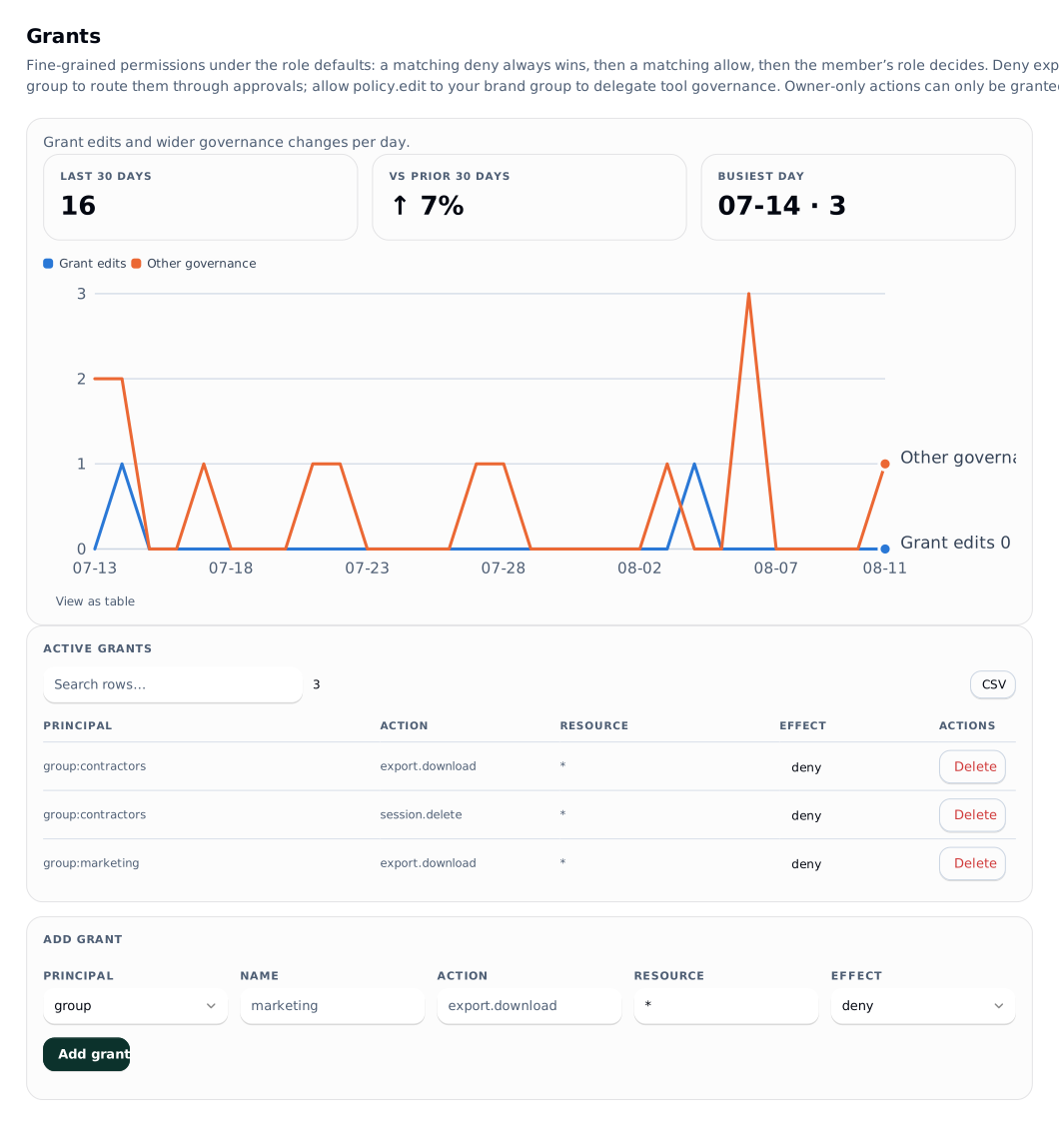
Grants
lw grants list
lw grants add group:brand policy.edit '*'            --effect allow
lw grants add group:contractors export.download 'tool:price-card' --effect deny
lw grants rm  group:brand policy.edit '*'
Also GET/POST/DELETE /api/v1/grants and the console's Grants view. All three are the same API - the console and CLI grow in parity by construction.
| Field | Form |
|---|---|
principal | group:<name>, user:<id>, or * |
action | any action id from the table above |
resource | a selector - *, tool:<id>, tool:tag/<tag>, catalog:tag/<tag>, … |
effect | allow or deny |
Grants take effect on the next request - there is no cache to bust and no restart. Every mutation is audited.
The escalation guard
A grant that creates or removes any owner-only action (instance.config, catalog.provider.credential, catalog.provider.publish, scim.manage, token.manage) requires the owner role, even though grant editing itself is an admin action. Attempting it returns 403 OWNER_ONLY_ACTION.
Only an owner may create or remove an owner-mapped local group, assign owner membership, or change an owner account's local groups. The same restriction applies to groups holding owner-only grants. Administrators may manage groups within their own role.
"Edit but not export"
This is the canonical fine-grained ask, and it is two rows:
lw grants add group:contractors tool.use        'tool:campaign-banner' --effect allow
lw grants add group:contractors export.download 'tool:campaign-banner' --effect deny
Deny wins, so the contractor can work in the tool and cannot take the file out. Tag selectors let the same pair cover a whole class of tools (tool:tag/external-facing) rather than enumerating ids.
Putting assets in: catalog.submit
catalog.submit is the action behind catalog submit, the one route by which a member's bytes enter the catalog. The author role carries it, and like any action it is grantable per group or per user, so "the design team may contribute, everyone else reads" is one row:
lw grants add group:design catalog.submit '*' --effect allowIt is deliberately the whole of the submitter's authority. There is no separate action for deciding a submission: when policy.submit.chain identifies a chain, the decision is an ordinary approval - eligibility is membership of the step's approver groups plus separation of duties (approvals), and the review queue is only an ergonomic door onto that review step. Whoever may act on the step may also correct a pending submission's declared metadata before publishing it - name, type, tags and description, never the bytes and never the exposure the submitter chose.
Three audit actions record the round trip: catalog.submit (on the way in, whether it was stored or refused), and catalog.approve-submission / catalog.return-submission on the way out. A metadata correction is audited as catalog.edit-submission with its before and after. Those are audit vocabulary, not grantable actions - nothing evaluates them.
Sending organization output: delivery.create
delivery.create is the manual use right for a fixed organization destination. Members carry it by default because the operator has already chosen, credentialed and explicitly enabled the target; groups exposure and resource grants can narrow each target independently:
lw grants add group:contractors delivery.create 'destination:campaign-archive' --effect denyAn explicit per-destination allow can also extend a target beyond its configured groups; for example, to give a viewer service token exactly one delivery capability without upgrading its role. The same deny-wins decision is used for discovery, creation and retry.
A matching deny removes that destination from the caller's org-config and is re-evaluated at the write boundary. The action has no authority over personal send targets: those remain on the person's device and never appear in Work configuration, grants, history or credentials.
Creation is audited once as delivery.created; every attempt then records delivery.delivered or delivery.failed. Permission loss stops new sends and retries but does not erase the caller's own historical receipts. Those are event names, not additional permissions. See outbound delivery.
When a destination names approvalChain, delivery.create authorizes staging and requesting review, not provider egress. The existing approval chain and separation-of-duties rules decide that. Approval delivers the immutable staged bytes; rejection/withdrawal are terminal and the retry route cannot bypass them. Service tokens are refused on a human-review-bound target.
The same action governs a completed automation render's publish command. It adds no ambient BlobStore authority: the caller must own the named job, it must be a settled render, its recorded format cannot be changed, and its retained bytes pass integrity and C2PA verification again. A delivery reference prevents deletion of that job output until retention releases the output.
Also catalog.read, which the viewer role already carries, gates the queue itself. The rows are the real gate: a caller sees their own submissions plus the ones open on a step their groups may act on.
Editing what the catalog says: catalog.edit
catalog.edit is the action behind org-defined metadata - filling in the fields an org defines for itself, and correcting an instance-owned asset's own name, description and tags. It sits with admin rather than with author, because contributing an asset and editing what the whole org's catalogue says about one are different authorities. Like every action it is grantable, so "the brand team files assets, everyone else reads" is one row:
lw grants add group:brand catalog.edit '*' --effect allowTwo things it deliberately does not buy. Defining the fields is policy.edit, because a taxonomy is governance and lives in the governance document - filling a field in is not defining one. And it reaches only assets the caller can already see: the editor asks the same exposure question link minting asks, so nobody annotates an asset that is invisible to them, and a submission still under review is edited through the review queue rather than here.
Audited as catalog.edit with the before and after of every field that moved, and as catalog.field.edit / catalog.field.delete when the definitions themselves change.
The same action carries the byte side of curation (versions): replacing a published asset's bytes with a new version, rolling the head back to a prior one, deleting a stored version, and retiring an asset in favour of another (replacedBy). The split is deliberate - catalog.submit contributes an asset, catalog.edit changes what an asset that is already in the catalog says or serves - and it is why a policy.submit.chain gates contributions and not versions: an approver already decided this asset belongs here. Audited as catalog.version, catalog.rollback and catalog.version.delete, each naming the version it moved.
<a id="curating-a-shareable-set-catalogcollectionmanage"></a>
Curating a shareable set: catalog.collection.manage
catalog.collection.manage is the action behind collections - creating a named, ordered set of catalog assets, naming the groups that may see it, and deleting it again. It sits with admin for the same reason catalog.edit does, and is grantable the same way:
lw grants add group:brand catalog.collection.manage '*' --effect allowOne rule is enforced rather than merely advised: a collection may only hold assets its curator can see. A collection link is minted on the collection's own visibility and its bearer then receives every member, so without that rule a curator with a narrowed grant could name assets they were never exposed to and read them back through a link. The check runs when the set is saved, where the person can be told which id was refused.
The mirror of it runs at mint, and is what closes the rule for everyone else: minting a link to a collection refuses any member the minter cannot see. link.create is a member default while curating is an admin action, so the saved-set check alone would only bind the curator - a collection visible to everyone could otherwise hand a member the bytes of an asset their own groups are denied. A refusal there reports how many members were unseen and not which ids, because the minter did not choose the membership.
Reading collections needs nothing extra: the per-caller catalog feed carries the collections a caller's groups admit, with members narrowed to the assets that caller is already served.
Audited as catalog.collection.edit and catalog.collection.delete, each with the before and after of the whole set; minting a link to one audits as link.create like any other link.
Explicit allow vs role default
Some decisions must distinguish "an explicit grant allows this" from "the caller's role happens to allow this" - tool visibility is the example: the member default of tool.use would otherwise un-hide every governed tool. Those callers use the explicit-grant decision (grantDecision), which returns allow / deny / none. It matters when you are reasoning about why a tool is or is not visible.
Guest write authority
A guest is never evaluated by the grants engine as a principal: server/src/collab/guests.ts imports nothing from rbac/. A guest's ability to write in a live collab room comes from the kind of the link that admitted it - guest-edit mints a writer seat, every other link kind mints no guest principal - never from a grant row naming the guest.
That asymmetry is easy to trip over. A grant like
lw grants add '*' session.edit '*' --effect denysilences every member's write access in a live room (mayEditCollab calls evaluate()) and reaches no guest: a guest's writer/observer split never runs evaluate() against the guest's own principal, so no grant, role change or group removal naming a guest decides anything.
One action is the exception, and it is the one that matters: link.create-guest, evaluated against the INVITER. The gateway re-checks the inviter's standing on every gesture and every keepalive (guestInviterStanding → mayCreateGuestLinks → evaluate(), gateway.ts), so an inviter who loses that action stops minting links and loses the guests already holding them. Offboarding an inviter is therefore a live eviction, not a change that takes effect at the next mint.
Four levers, then - three that act on the guest, one that acts on the inviter:
| Lever | Effect |
|---|---|
An inputAccess rule (governance) | Locks, hides or choice-restricts one input for every guest, in every room, without naming anyone. See the fallback below - it reaches a guest whether or not the rule identifies one. |
Revoking the link (POST /api/v1/links/:id/revoke) | Kills that guest's write access on its very next gesture - the room re-reads the link per gesture and per keepalive, the same cadence a member's grant revocation takes effect on. |
guestLinks.enabled: false (configuration) | The instance-wide kill switch. Stops new links from minting and evicts every guest already connected - re-checked live, not only at mint time. |
Taking link.create-guest off the inviter - a deny grant, a role change, removing them from the group that carried it, or disabling the account | Evicts every guest that inviter admitted, on the guest's next op or keepalive. The one lever that covers links nobody can enumerate; it leaves guests invited by anyone else alone. |
The inputAccess lever is one-way for guests: governing an input at all locks it for them. A guest carries only the synthetic guests group and never inherits the member-side editable fallback (vetoOps + inputIsGoverned, INPUT_LOCKED) - even {"groups": ["guests"], "level": "editable"} resolves to locked in a live room. An input with no rules stays editable for everyone, guests included.
What is not a lever: a grant naming the guest, and any action other than link.create-guest. Those never reach the path a guest's write decision takes.
Checking your work
Never guess what a person will see - ask the same assembler the live client polls:
lw preview --groups marketing,contractorsor the console's Preview view, or GET /api/v1/org-config/preview?groups=…. It reports the resolved role, permissions, tool visibility, per-input governance and profile policy for that group set. Because it runs through the production code path, it cannot drift from what the member actually receives.
Related
- Locking individual tool inputs, not just whole tools: governance
- Who can approve what: approvals
- Exporting the whole grant set as code: governance
- Every action's route: api