Beatrice Warde
20 September 1900 – 16 September 1969
In 1932 a typographer wrote fourteen lines about what a printing office is for. They were set in Eric Gill's Perpetua Titling for a Monotype type specimen, and they got away: reprinted more than possibly any other broadside in the trade, translated into seventeen languages, cast in bronze in Washington. Ninety-four years later they describe this project better than anything we have written about ourselves.
So we adapted them. This page shows you what she wrote, what we changed, and who she was.
What she wrote
The 1932 setting was capitals only, because the broadside existed to show off a titling face. Every mixed-case version you have ever seen is already somebody's adaptation. This is the reading best supported across the sources, in the British spellings of the Surrey company that first printed it:
This is a Printing Office
Crossroads of civilization
Refuge of all the arts
against the ravages of time
Armoury of fearless truth
against whispering rumour
Incessant trumpet of trade
From this place words may fly abroad
Not to perish on waves of sound
Not to vary with the writer's hand
But fixed in time
Having been verified in proof
Friend, you stand on sacred ground
This is a Printing Office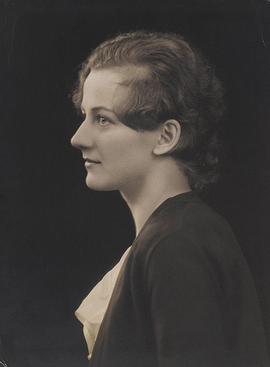
warde-1925.jpg an unknown photographer made this side-profile portrait of Beatrice Warde about 1925, soon after she reached London public domain — a century on, an anonymous 1925 photograph has outlived copyright everywhere it was ever protected: in the United States, where anything published before 1930 is now free; and in the United Kingdom and Europe, where an anonymous work passes into the public domain seventy years after publication Lolly published it in good faith, and will honour any rights-holder who comes forward
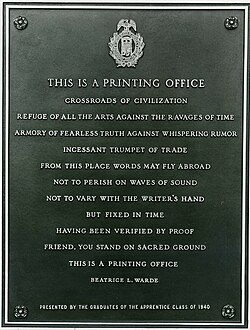
printing-office-plaque.jpg U.S. Government Printing Office historic photo gallery public domain, a work of the United States federal government under 17 U.S.C. 105 Lolly published it unaltered
Hear it
warde-printing-office.opus Google AI Studio generated a reading of Warde's original Gemini speech model, voice Sulafat, transatlantic accent, empathetic read — generated audio, not a human reader Lolly directed and published it signed by Lolly
What we made of it
Lolly is a Production Studio
Crossroads of civilization
Refuge of all the arts
Against the ravages of time
Armoury of fearless truth
Against whispering rumour
Incessant trumpet of trade
that no impostor can sound
From this place ideas may fly abroad
Not to perish on shores of change
Not to vary with the writer's hand
But fixed in time
Having been verified in proof
Friend, you stand on sacred ground
Lolly is a Production Studio
Hear it
warde-production-studio.mp4 Lolly produced and signed the audiogram a waveform drawn from the audio, its full history sealed inside the file, the voice within declared as AI-generated Google AI Studio generated the voice Gemini text-to-speech, voice Sulafat, Australian accent, energetic read - generated audio, not a human reader signed by Lolly
The words are Warde's; the reading is a 2026 Australian one, and the voice is a model. Lawrence Lessig said creativity always builds on the past. It does - but the debt runs both ways: the future owes the present the plain truth of what it borrowed and how it was made. So we label the voice as generated now, while a machine still sounds like one, because a safeguard that only holds while the technology is crude is a postponement, not a safeguard. The proof rides inside the file - the AI origin declared in its credential - and you can verify it yourself. Fixed in time, having been verified in proof.
Three changes and one addition, and we would rather list them than let you find them:
- "This is a Printing Office" becomes "Lolly is a Production Studio", in the first line and the last. Her subject was a room with presses in it. Ours is a room that emits PNG, SVG, PDF, video and audio. The claim is the same claim.
- "words may fly abroad" becomes "ideas may fly abroad." Lolly is not a text tool.
- "Not to perish on waves of sound" becomes "Not to perish on shores of change." Her contrast was writing against speech, the permanent against the spoken. Ours is the permanent against version drift, dead links and lapsed subscriptions.
- We added one line. After "Incessant trumpet of trade": "that no impostor can sound." Her boast was that the press heralds the trade. Ours is that the herald cannot be faked. It is the only line here that is not hers, and the place the adaptation stops borrowing and answers - because she beat an impostor problem by becoming an impostor, and a Lolly file is a trumpet no impostor can sound.
Everything else is hers, including the line this whole page is about - and including the one that now reads like prophecy. "Not to vary with the writer's hand" meant a copyist corrupting a text as he wrote it out again, adding what he liked and dropping what he didn't until it had taken on a life of its own. The writer's hand today wears many gloves: a model retraining on its own output until the copy forgets the original, a file that only opens in software no one sells any more, a link that rots, a re-upload that silently strips the credit, a subscription that lapses and takes your work hostage. Different hands, faster or slower, the same corruption. She met hers with a press. We meet ours with a file that stays fixed and carries the proof of what it is.
Fixed in time having been verified in proof
Warde meant a proof pull: the sheet you take off the press and check before committing to the run. The word survived into our trade almost unchanged, then quietly acquired a second meaning she could not have intended.
Every Lolly export carries its own record - a signed, machine-readable account of what a file is, what it was made from, and what was done to it. Proof in her sense is the check before the run. Proof in ours is the check anyone can run afterwards, on the finished file, without asking us. Same word, same job, ninety-four years apart. You can verify it yourself.
Who she was
Beatrice Lamberton Warde, born Becker in New York on 20 September 1900, daughter of the Herald Tribune book critic May Lamberton Becker and the composer Gustave Becker. She was shown calligraphy at thirteen, took her degree at Barnard in 1921, and went to work as assistant librarian at the Typographical Library and Museum of the American Type Founders Company in Jersey City, under Henry Lewis Bullen. She left for Europe in 1925.
In 1926 The Fleuron published "The Garamond Types, Sixteenth and Seventeenth Century Sources Considered." The argument: the types held at the French royal printing office and sold across the trade as Garamond's were not cut by Claude Garamond at all. They traced to Jean Jannon of Sedan, on the evidence of his 1621 specimen sitting in the Bibliothèque Mazarine. The misattribution had entered print in 1845 and nobody had gone back to check.
The author was named as Paul Beaujon, a man who did not exist, with an invented biography to go with him. She was twenty-five. When Monotype offered Beaujon the editorship of The Monotype Recorder in 1927, the executives were expecting him to be a man. She took the job, became head of publicity in 1929, and stayed until 1960.
She kept writing as him. The phrase every designer knows first appears under the Beaujon name in 1933, in an essay called "On the Choice of Type Faces", and it is usually quoted with its first half cut off:
"People who love ideas must have a love of words. They will take a vivid interest in the clothes that words wear."
- Beatrice Warde, collected in The Crystal Goblet, 1955
The half that gets dropped is the half that makes it an argument. Loving ideas obliges you to care about words, and caring about words obliges you to care how they are dressed. Meaning is not changed by its setting, but its reception entirely is: the same sentence in the wrong face is a different sentence to the person reading it. That is the case for rigour at scale, made in two lines by a woman writing under a man's name because the trade would not print her own.
So the woman who wrote "fixed in time having been verified in proof" is the same person who went to the archive, found a three-hundred-year misattribution, published the correction under a false name because that was the price of being read, and then had to claim it back as her own.
She died in Epsom, Surrey, England on 16 September 1969.
What we take from her
- Quality. Her argument in the crystal goblet essay is that the craft succeeds by disappearing: you should see the wine, not the glass. Constraint-first tooling is the same bet. The template holds the brand so the person using it can think about the message instead of the margins.
- Correctness. She checked. The whole trade had been calling a typeface by the wrong name for three centuries because nobody had. Every claim on this site is paired with the mechanism that enforces it, and none of them ask for your trust.
- Fairness. She had to invent a man in order to be read - a false name and a false biography, the whole apparatus of a person who did not exist, because that was the price of being printed. That is not a charming anecdote, it is what the field cost her. Her story is familiar to anyone who has had to mask who they are, or reinvent themselves, to be taken seriously in a room that was not built for them - which is why who gets to make things is a design decision here rather than a footnote.
- Attribution. This is the one she is owed. Provenance is on by default here, and the chain covers ingredients as well as edits, so a work's history travels with it instead of being reconstructed by a stranger later. We adapted her in public and listed our changes.
Adapted from Beatrice L. Warde's "This is a Printing Office", first printed in 1932 by the Monotype Corporation, Salfords, Surrey. Reproduced and adapted here with attribution, in the tradition of a text the printing trade has reprinted, translated and reset for ninety-four years. First printed in 1932, not yet out of date.