
This guide covers the optional organisation service. Configuration, console and API paths refer to your Work instance. The packaged console keeps its release-matched copy of this guide.
Implementation status and the work still needed for customer acceptance. The guided setup milestone and deployment checks below were verified on 2026-10-02. Configuration checks, local integration fixtures and live customer acceptance are recorded separately.
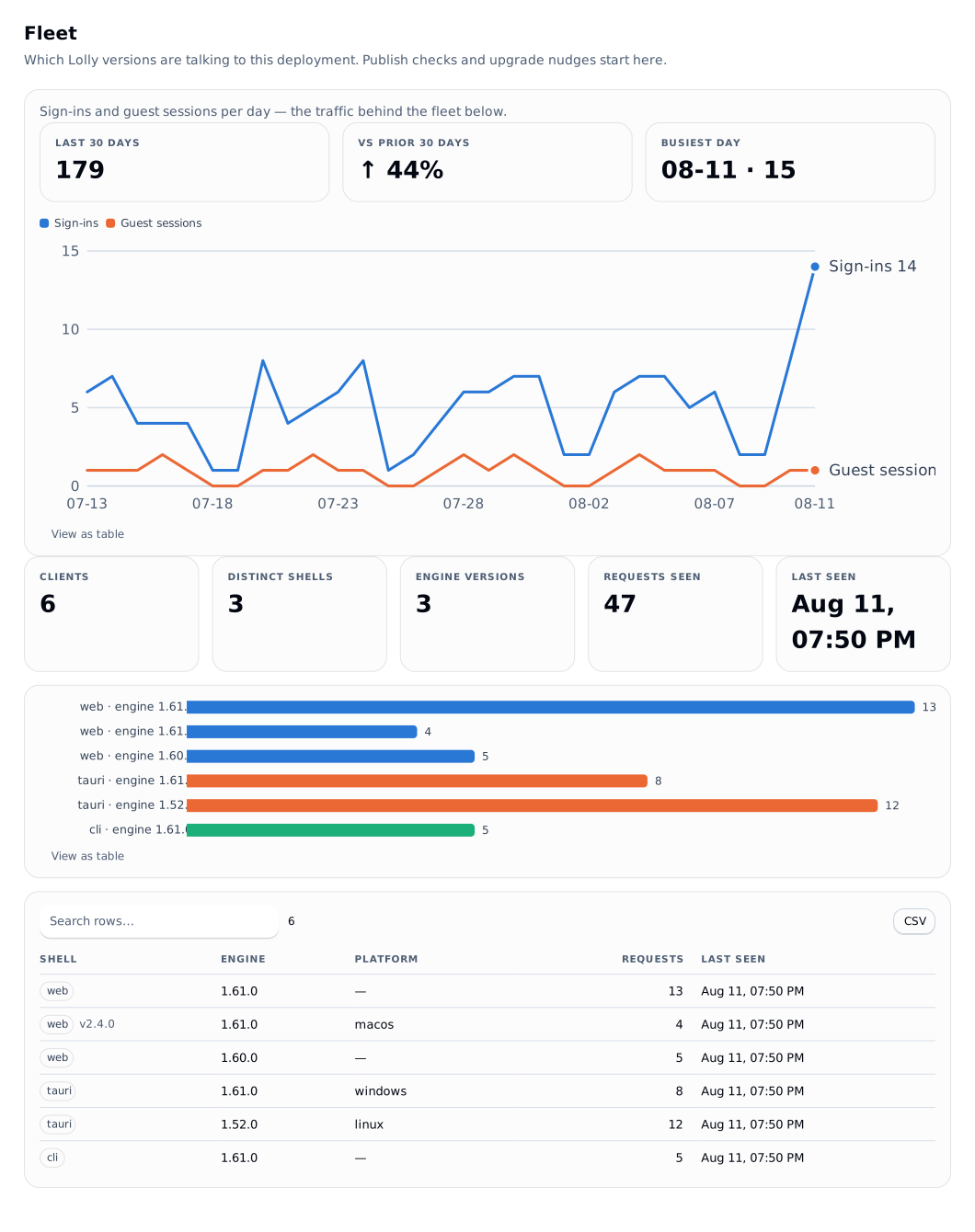 signed by Lolly Demovector SVG自分で確認する署名済みファイルを取得10 paths128 nodes141 groups194 KB
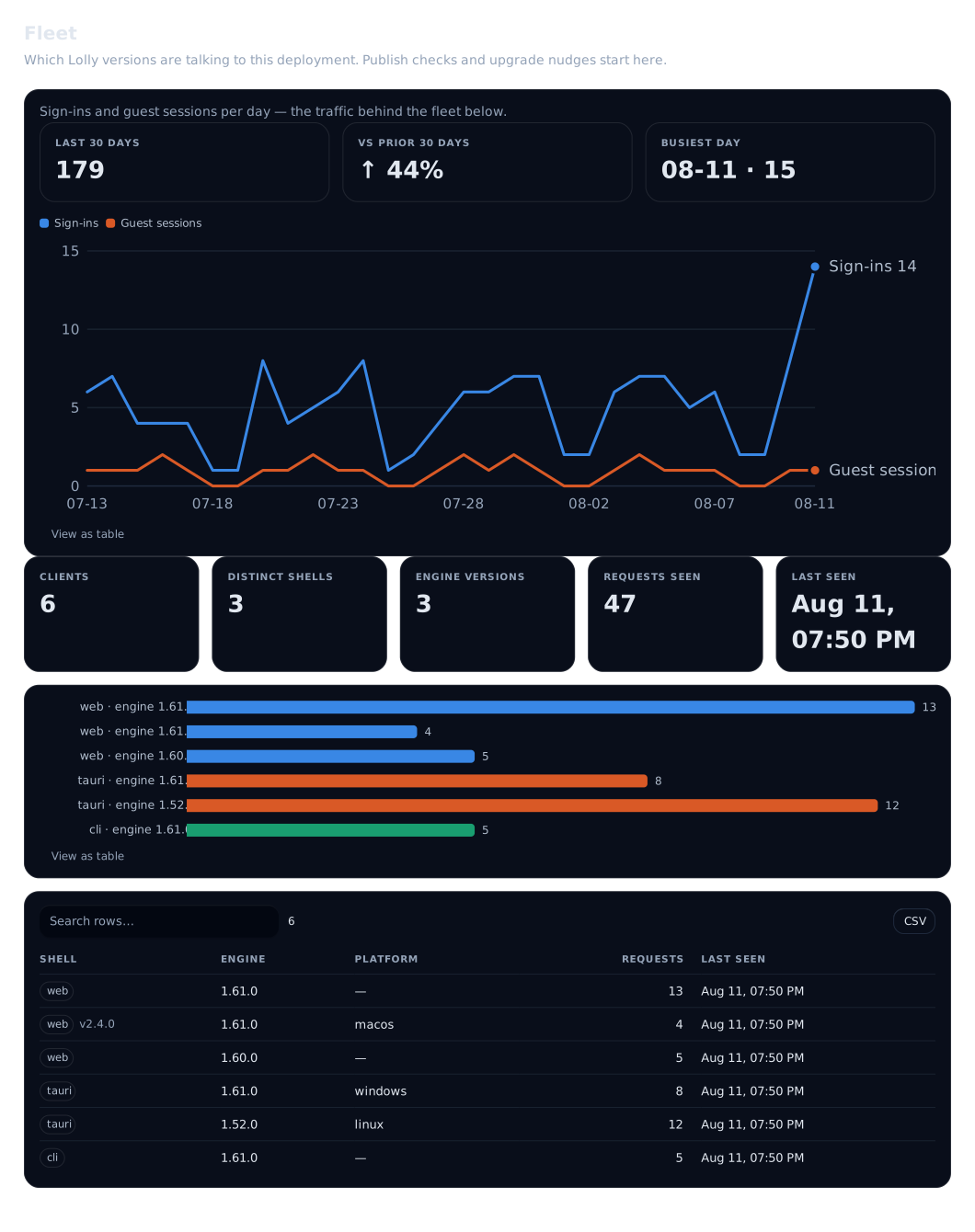 signed by Lolly Demovector SVG自分で確認する署名済みファイルを取得10 paths128 nodes141 groups194 KB


Guided setup update, 2026-10-02
The new Customer setup journey provides six guided steps, validated non-secret deployment files, a backed-up source-config apply command, applied-settings checks after restart, exact customer group mappings, bounded installed OIDC discovery, observed owner sign-in, SCIM subject correlation and a checked downloadable sample. SCIM role changes affect existing sessions; disable revokes access. Tokens, policy, source administration and chain editing remain on their existing governed screens.
Verified with signed-JWT OIDC/SCIM HTTP fixtures, current permission denial, output digest and evidence checks, memory/Postgres conformance and Chromium desktop/phone light/dark. Live customer tenants and released client/worker artifacts still need their selected integration tests. WebDAV / Nextcloud now has typed source setup, a bounded paged listing and original checksum, credential retry and sync-before-enable. Google Drive now has typed folder/group configuration, registered browser consent, sealed refresh-token capture, recoverable saved-source previews and activation guarded against changed settings or credentials. Shared drive flags and skipped native-document diagnostics are included. The guide and app explain exact redirect registration, consent audience and testing-token expiry. Other provider forms/browser consent, application service-token scopes/expiry, coordinated editable defaults and exact release contracts remain deferred. Live Google Workspace/customer acceptance remains outstanding.
Setup milestone local verification: 1,142 tests, 1,123 passed, zero failures and 19 conditional skips; isolated Postgres conformance/rollback passed separately. Twenty new Google setup checks cover consent/session revocation, stale settings, bounded reads and console recovery. Chromium rehearsed Google consent fixtures across an app restart, original-file checks, group access, disable/resume and desktop/phone light/dark. WebDAV's HTTP/browser rehearsal also passed after sharing the typed fields. Typecheck, documentation/comments, engine pin, SBOM freshness and both production dependency audits passed.
The latest verified implementation passed CI with Postgres enabled: 1,159 tests, 1,153 passed, zero failures and six conditional skips. Both deployment container images built successfully. The public demo's health endpoint, guided provider module and a real SVG render also passed live checks.
Deployment verification also exposed missing engine subpaths, a source-relative runtime import and jsdom dependencies incompatible with the hosted require(ESM) restriction. The build now packages the pinned engine's full public export map, uses its public version helper, runs on Node 24 and converts the affected dependency entries in the output package. CI exercises jsdom parsing/selectors/styles, boots the packaged function, checks console/setup routes and renders a real SVG with require(ESM) disabled before permitting deployment.
Engine source update, 2026-10-09
The maintained source pins engine 1.248.0, core 1.1.0 and 33 schemas from upstream commit fa6779d5cc5b064bb71911c04b90f9ac16caf054. The consumed source hashes and HostV1 bridge version remain verified; third-party dependency versions and the Handlebars 4.7.10 override are preserved.
Local source checks passed with disposable PostgreSQL 17.11: 2,214 tests, 2,206 passed, zero failures and eight conditional skips. Typecheck, engine pin, root/worker production audits and SBOM freshness also passed. These source checks do not select or deploy matched shell, pack, worker and engine-pin artifacts for an existing instance.
Verification and packaging
| Area | Verified state |
|---|---|
| Setup milestone local tests | 1,142 tests; 1,123 passed, zero failures, 19 conditional skips. Postgres checks also passed in an isolated local database. |
| CI tests | 1,159 tests; 1,153 passed, zero failures, six conditional skips with Postgres enabled. |
| Deployment gates | Full tests and packaged function rendering, typecheck, root/worker production dependency audits, SBOM freshness, server and render-worker image builds. |
| Engine consumption | Pinned, unmodified engine 1.248.0 and core 1.1.0, verified before tests. Pack inspection checks manifests, required files and available server formats. |
| Documentation images | SVG captures of the real local console, with embedded fonts, paired light/dark variants and signed screen-capture credentials. Examples contain evaluation data. |
| Release qualification | Passing app CI does not select or certify a matched employee-client, worker and deployment-image release for a customer. |
Remaining customer acceptance work
| Work | Current boundary and reopening condition |
|---|---|
| Customer identity and source | Verify the selected tenant's registered callbacks, real owner groups, SCIM subject correlation, known original checksum, denied groups, revocation and source disable. Follow Customer setup and the selected provider guide. |
| Other guided provider forms | WebDAV / Nextcloud and Google Drive are implemented. Other kinds retain advanced configuration and documented CLI consent where available; add the selected customer's next provider when its contract is known. |
| Service-token scopes and expiry | Role assignment, last use and revocation are implemented. Narrow scopes and expiry require credential and authorization changes. See Identity. |
| Editable defaults | Manifest defaults and governed locked values are available. Editable overlay defaults still need one agreed precedence across clients, collaboration, automation and server renders. |
| Matched releases and delivery | Qualify the actual employee clients, worker formats, deployment images and mounted shell/pack. Current setup and pack inspection do not certify those artifacts. |
| Approval-bound ordinary exports | Reviewer permission, chain editing and separation of duties are implemented. Binding an ordinary export to reviewed final bytes and until-approved watermarking remains separate work. |
| Publication and availability | Trusted central pack publication, HA and unattended delivery recovery need their selected deployment contracts and acceptance checks when required. |
What is built and tested
- Recoverable single renders (
/api/v1/renders,lw renders): principal-owned requests, atomic idempotency, expiring claims, heartbeat/fenced completion, bounded retries, cancellation and digest-verified retained output. Standalone startup recovers queued/expired work; persistence needs Postgres and durable BlobStore. Durable render batches (/api/v1/render-batches,lw render-batches) commit parents and children together, recover individual rows, retain a JSON manifest and retry unsuccessful rows while reusing successes. New outputs retain partial execution evidence for loaded sources, context and observed asset bytes, committed with the output under the same lease. Full dependency locking and campaign reconciliation remain next slices. See Recoverable renders.
- Deploy config + fail-closed secrets; OIDC login (discovery, PKCE, JWKS-verified), dev provider, member and guest sessions with domain-separated tokens.
- RBAC evaluator (roles + deny-wins grants) with the owner-only escalation guard; the grants editor in console, CLI and API.
- Tool overlays (editable/choice/locked/hidden, hidden = absent), the enforce block, feature- flag governance, profile locking - plus
org-configand preview-as-group, computed through the same assembler the live client polls. - Policy-as-code: canonical export, dry-run diff, apply, prune, boot seeding.
- Render plane v1: real engine, jsdom fast path, svg + png (resvg), policy enforced pre-render, LRU + ETag, PREVIEW watermark, C2PA-shaped provenance embedded in SVG/PNG, real C2PA signing when an identity is configured.
- Links: mint/verify/expire/revoke, passwords, guest admission with TTL caps.
- Approvals engine (any/quorum/all, nomination, separation of duties) with per-user inbox.
- Catalog: pack serving with per-caller filtering, lifecycle (schedule/expire/revoke), fifteen provider kinds with sealed credentials, exposure governance and live search fan-out, plus the exit (materialize, drift, cutover) and publish-out to Optimizely CMP.
- Cloudinary and Orange Logic shared sources: advanced console setup, scoped discovery, redacted diagnostics and explicit file roles. Cloudinary streams original files by asset ID; Orange Logic exposes public API renditions and refuses DAM cutover. Both are fixture-verified; customer tenant qualification and Orange Logic protected-original API access remain open.
- Catalog submit: members with
catalog.submitadd assets from a browser or the CLI, with a size cap, per-group quotas, checksum dedupe, an operator-pluggable pre-store scan hook, C2PA detection, and optional review through an approval chain. - Outbound delivery: fixed, group/RBAC-scoped organization targets with S3-compatible, WebDAV and signed-HTTPS adapters, shell presentation beside (never over) personal targets, C2PA and byte gates, optional approval-chain binding over immutable staged bytes, immutable durable receipts, idempotency, retry and audit. Completed automation renders publish by reference to the same retained bytes, scoped to the job principal and protected from deletion while in use. No target is configured by default, and personal device targets remain outside the control plane.
- Org-defined asset metadata: an org identifies its own fields (text/select/date/url, required or not) in the governance document and fills them in on pack, federated and instance-owned assets alike through
catalog.edit; the values ride the feed and the search haystack. - Collections: named, ordered, group-visible sets of catalog assets, curated behind
catalog.collection.manage, listed additively on the per-caller feed, and shareable as a signed link that serves a brand-chromed listing page and a zip-all - that set only. - Asset versions: new bytes for an existing instance asset become version N+1 under the same id and URL, prior versions stay readable at a gated
?v=N, rollback moves the head, a hold refuses version deletion, retention ispolicy.catalog.versionKeep(keep-all by default), and a head move busts the render cache. Supersession (replacedBy) retires an id in favour of another and rides the feed additively. - Telemetry ingest (closed allowlist, attribution at the door), rollups, activity feed, fleet registry, hash-chained audit log with an anchorable head.
- Postgres store + migrations runner behind one conformance-tested seam.
- Admin console (
/admin) andlwCLI over the same API - including this documentation set at/admin#/docs. - Packaging: a working container build (
deploy/compose/Dockerfile), Compose, and a Helm chart with NetworkPolicy/ServiceMonitor/non-root defaults, a migrate Job, pack and shell volumes, and an optional render-worker tier.
Open gaps, in the order they will bite
1. Session revocation - largely closed
Sessions are stateless signed tokens with a policy.sessionTtlHours lifetime, but disabling a person (console or SCIM active=false) is now instant revocation: it bumps the user's session epoch, a counter the token embeds at mint, so every live session of theirs is refused from that request on. bumpSessionEpoch is the same lever without a disable. What remains is narrow and mostly cosmetic: revocation is per user, not per individual session, and the role a shell's token claims is stale until the next mint (authorization is not - requireAction resolves the live record every request). Mitigation for the residual: lower sessionTtlHours. See identity.
2. Audit-head anchoring stops at the log line
Head logging is on by default (boot + hourly, audit.headLog). Migration 0034 adds keyed audit MAC storage and a PostgreSQL append guard, with a controlled retention delete path. A database superuser can still bypass the trigger or truncate the tail. Operators must collect heads in an independently retained external sink and verify receipt; local stdout alone is not an external anchor. See audit.
3. Deployment image qualification
The release workflow builds server and render-worker images on a v* tag with signatures, SBOM and provenance attestations; see image verification. The package version remains 0.2.0, while main includes the new setup work. Current CI builds both images but does not publish a new customer release. Select and verify the intended image digests, client and worker versions before installation. Confirm registry access in the target environment and configure imagePullSecrets if required; historical package visibility is not a current pull test.
4. Shell delivery on Kubernetes
Serving the web shell needs a built dist on a volume you populate; brand-pack delivery is likewise bring-your-own (pack.type defaults to none). The stale-dist boot guard means a wrong path now fails loudly instead of quietly un-governing employees, which is the improvement - not a substitute for a delivery pipeline.
5. Engine pin drift (a recurring risk, currently closed)
The vendored engine is pinned and pin-verified (engine-pin.json, @lolly/engine@1.248.0 and @lolly-tools/core@1.1.0 from committed upstream source on 2026-10-09). The pin is re-verified as pretest; engine-drift.yml reports upstream drift weekly and repin-engine applies a reviewed snapshot. inspect:pack and Customer setup now load manifests through the installed engine and report incompatible requirements, missing files and unsupported server formats. A matched release still needs its client and worker contracts checked; a green pin check alone does not establish them.
6. Postgres leg depends on CI
The Postgres driver only runs under LW_TEST_DATABASE_URL. CI now provides one, so this is covered on main - but a local pnpm test still exercises only the memory driver.
7. until-approved watermarking
always is wired; never is stored but never consulted (equivalent to unset); the per-render linkage between approval state and watermarking is deliberately not built yet. Set always if you need the guarantee today.
8. Vercel is a pilot vehicle
The hosted demo renders for real - GET /render/<toolId>.<format> serves live SVG/PNG bytes off the jsdom fast path (verified against www.lolly.work). What makes it a pilot, not production: it runs memory-only (no DATABASE_URL, so seeded/created state resets), there is no Chromium worker tier (only curated demo hooks opt into in-process rendering), and pack delivery is demo-scoped. Fine for a trial, not for production.
9. Employee client distribution
The Work repository's audits, SBOM and notices cover its own deployment. They do not clear the exact employee desktop/mobile binaries, their third-party notices or the client's distribution terms. Review those artifacts in the Lolly release being delivered. Earlier upstream license-map counts are not evidence about the current customer release.
10. Bus factor
One person commits to both repos. The plans directory and honest inline documentation are the mitigation; they are not a substitute for a second maintainer.
11. Approval permission and policy limits
Approval actions, reviewer selection, nomination and notifications now evaluate approval.act alongside step-group eligibility and separation of duties. Custom reviewer groups may need an explicit allow grant. The overlay enforce keys c2pa and escalation remain declared but unsupported by write paths; until-approved does not yet bind an ordinary export to an approval. The console identifies unsupported settings. See governance and approvals.
Roadmap shape
The plan sequences phases so each is independently useful:
| Phase | Content | State |
|---|---|---|
| 0 | scaffold, schema, CI, workers, compose, Vercel trial | done, Vercel trial-grade |
| 1 (MVP) | SSO + catalog + render/links + fleet + audit core | done |
| 2 | roles/grants, overlays, profile governance, org-config, message bridge | done; org-scoped MCP endpoint outstanding |
| 3 | approvals, watermarking, lifecycle, C2PA assertions | largely done (see gap 7) |
| 4 | shared workspaces, collab presence, telemetry dashboards | projects/sessions and dashboards done; server collab substrate done single-node (ws gateway + rooms + persistence + guest join, server/src/collab/); employee-client release and rollout acceptance remain separate |
| 5 | SAML/SCIM, SIEM streaming, live co-editing, air-gap hardening | SCIM done (/scim/v2: Users create/patch/active=false, Group membership, per-IdP bearer tokens - plans/31 section 8); SAML deliberately deferred to Keycloak's SAML→OIDC bridge; live co-editing server side done but rollout stays adoption-gated (the conflict counter on the console Overview is the gate's instrument); SIEM forwarding done (plans/35: batched, cursor-tracked, lw_siem_lag gauge - see operations) |
The community gate is worth restating, because it is the test of the brand-agnostic claim: someone who is not us stands a deploy up from the Helm chart.
Next work towards a customer launch
- Select the customer's identity/source and qualify the real integration using the setup and provider guides.
- Qualify and publish matched deployment, worker and employee-client artifacts, then rehearse installation with their digests and registry access.
- Narrow service-token authority and expiry, then agree editable-default precedence across the selected clients and render paths.
Audit anchoring, HA, central publication and recovery stay conditional on the deployment's requirements. The table above records the application's deliberate deferrals; the setup screen shows which configured integrations have actually been observed.