
This guide covers the optional organisation service. Configuration, console and API paths refer to your Lolly Work instance. The packaged console keeps its release-matched copy of this guide.
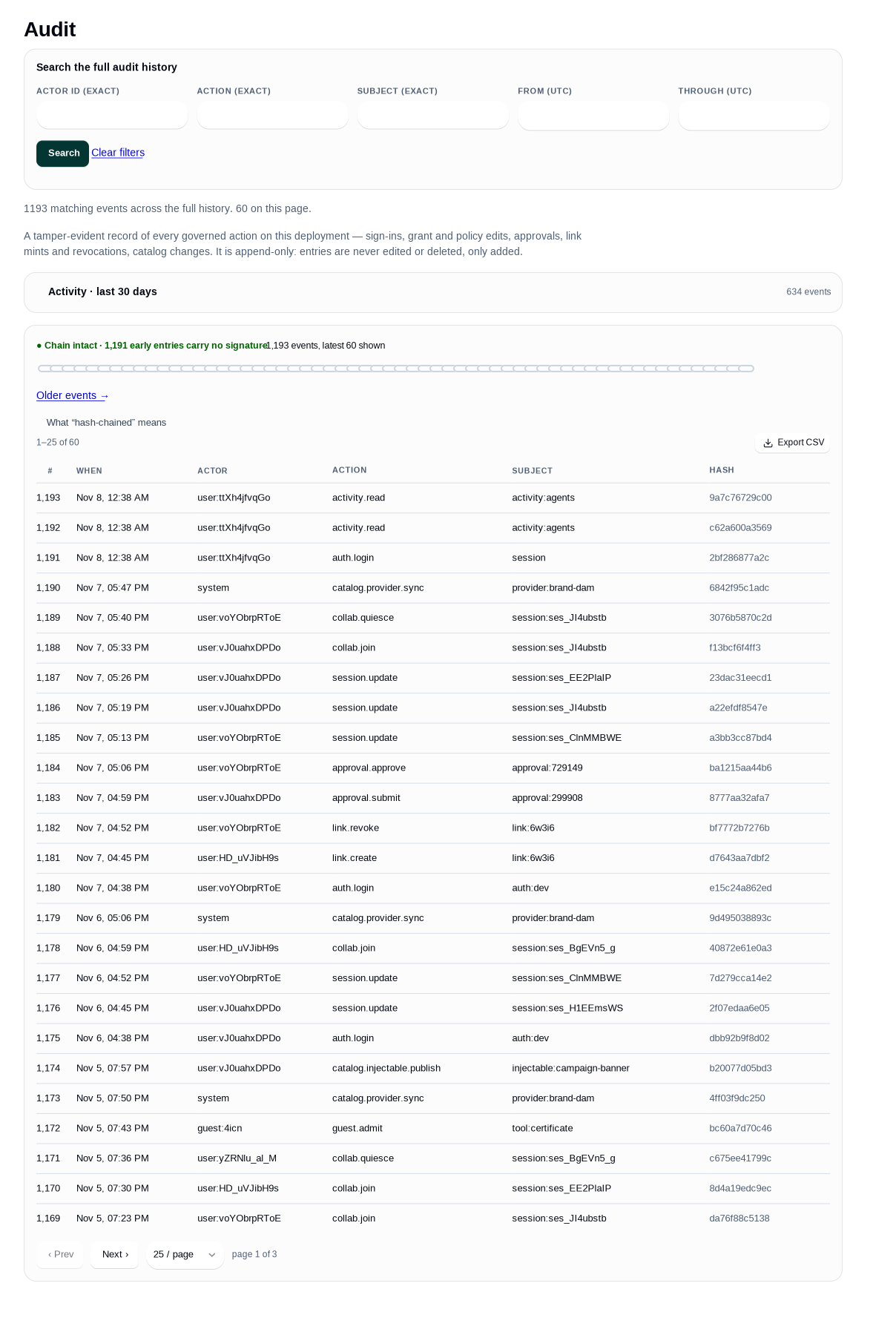
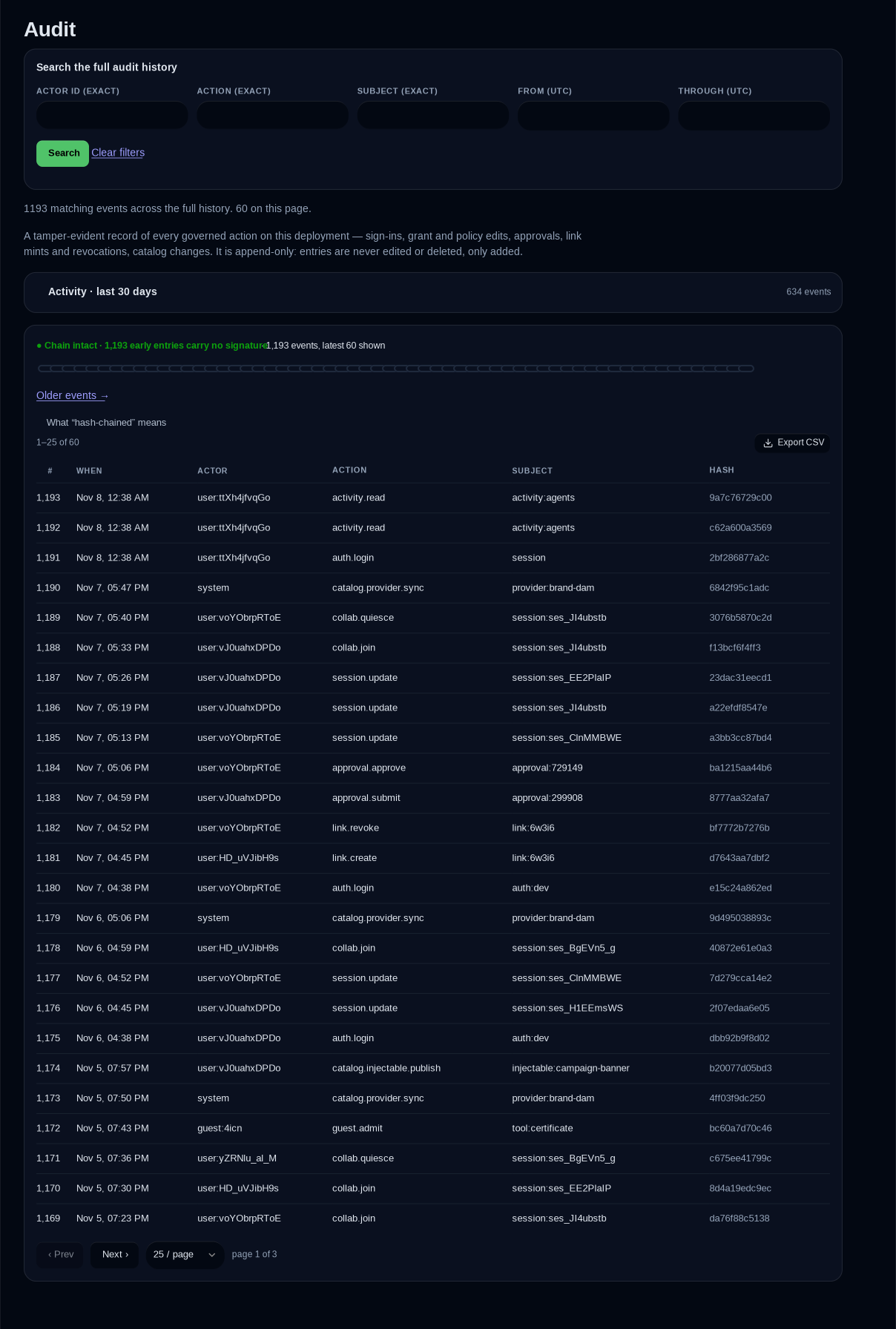
Lolly Work keeps a tamper-evident, append-only record of every governed action on this deploy: sign-ins, grant and policy edits, approvals, group and lockout changes, link mints and revocations, provider changes, catalog changes and configuration applies. Admins read it in the console and auditors export a copy. Anyone who holds a copy of the head can later show that nothing was edited or cut off the end.
Entries are never edited, only added. They are removed only by stated retention: policy.retention.auditDays trims rows older than the window behind an anchor (seq and hash) that keeps the chain verifiable (operations).
 signed by Lolly Demovector SVG13 paths141 nodes297 groups1 image248 KBCheck it yourselfGet the signed file
 signed by Lolly Demovector SVG13 paths141 nodes297 groups1 image247 KBCheck it yourselfGet the signed file


Read and filter the log
The console's Audit view and the Activity feed read the same rows for different jobs. Audit is the authoritative record, with chain verification. Activity is the readable merged timeline (audit plus attributed telemetry) with actor and category facets. audit.export gates the raw API. A service token with the audit.read scope can read the trail and its head, for an audit poller with no session cookie (service tokens).
The console filters the full retained history, before pagination, by exact actor ID, action and subject, plus an inclusive UTC date range. The API accepts actor, action, subject, since, until, limit (up to 1000) and before (a sequence cursor):
GET /api/v1/audit?action=approval.submit&limit=50Responses include total for the retained log, matched for the full filtered history, and nextBefore for an older matching page; keep the filters when following that cursor. Rows within each page stay in ascending sequence order. Invalid or reversed date ranges are rejected. Actor filtering uses stored IDs rather than a broader identity-directory lookup.
The chain verdict covers the complete retained chain, not the filtered rows, because filtered rows alone cannot prove the chain is continuous.
How the chain works
The audit chain
seq 410
body
policy.overlay.edithashH(hash 409 + body)
MACHMAC(key, hash)
seq 411
body
approval.submithashH(hash 410 + body)
MACHMAC(key, hash)
seq 412, the head
body
auth.loginhashH(hash 411 + body)
MACHMAC(key, hash)
- A copy off the server
The head's seq and hash, printed at boot and every hour, kept by a log service or ticket you control
The MAC key is derived at boot from LW_SESSION_SECRET. The database never holds the key.
- An editbreaks the hash link at that row
- An edit that re-chains the hashesstill fails the MAC
- Dropping the newest rowsleaves a chain without the head you kept elsewhere
Each part catches a different kind of tampering: the hash links catch an edit, the MAC catches an edit that re-chains the hashes, and the head kept elsewhere catches rows dropped off the end.
signed by Lollywork-audit-chain.htmlHTMLpixels, not shapes9 KBAI generatedgenerated by Claude Opus 5.5Check it yourselfGet the signed fileEach event's hash covers the previous event's hash plus the canonical JSON of the event body. An in-place edit or a truncation therefore breaks the chain at a specific sequence number. Verification walks the chain and reports either "intact" or the first bad seq.
GET /api/v1/audit?limit=…        # entries + a chain verification result   (audit.export)
GET /api/v1/audit/head           # the current head: seq, hash, count, chainIntact
lw audit verify # exits 2 if the chain is broken
lw audit head # prints seq · hash · count · intactThe console's Audit view shows the same chain with its verification state, and the lw_audit_chain_intact Prometheus gauge (1 or 0) is the signal to alert on.
Payloads must already be privacy-safe when they are written: digests and field names, never raw input values. The chain module does not inspect them; the call sites are responsible, and policy edits record before and after shapes.
The keyed MAC
The hash links alone could be recomputed by someone who edits the database. So every row also carries a keyed MAC: an HMAC of its hash under a key derived at boot from LW_SESSION_SECRET, which the database never holds. A database holder who edits a row and recomputes the public chain from there on still cannot produce MACs that verify, and every verification path (/api/v1/audit, the head, the Prometheus gauge, lw audit verify) checks them.
Rows written before the key existed have no MAC. Verification counts them as unkeyed rather than failing them, but only at the start of the log: every host installs the key before it writes, so once a row has a MAC, every later row must have one too. A row without one after that point is a stripped MAC and breaks the chain. The console's badge shows the unkeyed count when there are any. Rows signed under a session secret that has since been rotated are covered by a retired-key boundary.
On Postgres, migration 0034 adds a trigger that refuses UPDATE and DELETE on audit_log. The retention trim is the one delete the trigger admits, and the trim announces itself inside its own transaction after writing the anchor.
Anchor the head outside the server
Hash links and the MAC detect edits within the log. They do not, by themselves, stop someone with superuser access from dropping the trigger and deleting the newest entries: rows that no longer exist leave nothing to verify.
The defence is to keep the head hash somewhere outside this deploy. A later chain that does not contain the head you saved has been truncated, and you can prove the cut.
The server prints the head by default, at boot and then hourly:
[lolly-work] audit head seq=… hash=… count=… intact=…Collecting and keeping those lines is the operator's job. Ship them to an independently retained log service with controlled deletion access, and check receipt and retention there.
Local journald, a local file or kubectl logs alone can disappear with the host or deployment.
The timer is unref'd, so it never holds the process open. The defaults are
"audit": { "headLog": { "onBoot": true, "intervalMinutes": 60 } }and { "onBoot": false, "intervalMinutes": 0 } turns the log line off. Do that only if you anchor the head some other way, because an unanchored chain is the gap this closes.
For a stronger anchor than log retention, one you can hand an auditor, snapshot the head somewhere append-only on your own cadence, such as a scheduled job that commits it or a ticket per release:
lw audit head --json > audit-head-$(date +%F).json # commit it, ticket it, ship it to a sinkRotating the session secret
The MAC key is derived from LW_SESSION_SECRET, so a new value means a new key. Every row written before the rotation stops verifying, and the chain reads as broken at the first of them. lw audit retire-key records a boundary that tells verification those rows were signed with a retired key. The way through depends on whether you still have the old value:
- The old value is known. Deploy the new value with
LW_SESSION_SECRET_PREVIOUSset to the old one (operations), so sign-ins carry over. The audit MAC uses the current key only, so also runretire-keywhile PREVIOUS is still set: it first checks every row it is about to retire against the previous value, and refuses if a row verifies under neither. - The old value is gone, for example because the platform stores secrets write-only. Nothing can check the old MACs again, so follow the steps below in order.
- Record the head while the server still runs the old value.
- Deploy the new secret to every host that writes to this database.
- Sign in once, so a row exists under the new key.
- Run
retire-key --dry-runwith the recorded head, and read what it would retire. - Run
retire-keyto append the boundary. The chain reads as intact again.
Before you rotate: record the head
While the server still runs the old value, record the seq and public hash of the last row, and whether every row verifies under that value:
lw audit head --json                                              # through the API
docker compose exec -T server node scripts/audit-head.ts --json   # in the server container
scripts/audit-head.ts reads the database directly and never writes. Besides the head it prints linksIntact (the hash links alone, no key). Keep the seq and hash: after the rotation, retire-key --expect-head <seq>:<hash> refuses unless that row still has that hash, and the hash links pin every row before it, so nothing up to the head can be rewritten between the rotation and the boundary.
Recording the boundary
Once every host runs the new value, sign in once: the server writes that sign-in under the new key, and the command needs one such row. Then:
lw audit retire-key --reason "secret rotation 2026-10-04" --expect-head 412:9f2c… --dry-run
lw audit retire-key --reason "secret rotation 2026-10-04" --expect-head 412:9f2c…
# in the server container (the image carries scripts/, not cli/):
docker compose exec -T server node scripts/audit-retire-key.ts --reason "secret rotation 2026-10-04" --expect-head 412:9f2c…
The command talks to the database directly and needs DATABASE_URL and LW_SESSION_SECRET, which the server's environment has. It appends one row, action audit.key.retire, MAC'd under the current key. The row records retiredThroughSeq and retiredHeadHash (the seq and hash of the row directly before it), the reason, how many rows it retires, whether they were checked against a previous value, and the head it was given (expectedHead). Keep the reason to why ("secret rotation"), not who. The row is appended only while the log still ends at the row it points to, so two runs at once write one boundary, not two.
The command writes nothing when the chain already verifies under the current key. Exit codes: 0 for a boundary written or nothing to retire, 1 for a usage or environment problem, 2 for a refusal or a chain that still fails after the boundary.
When retire-key refuses
Before it writes, the command checks that the rows since the last boundary look like a key change and nothing else. Otherwise it refuses, writes nothing and exits 2:
broken: a hash link is broken. That is an edit or a deletion.head-mismatch: the row given with--expect-headis gone or has another hash.stripped: a row has no MAC although an earlier row has one.interleaved: a row that verifies under the current key comes before one that does not. A key change leaves the old-key rows first and the current-key rows after them, so this means an edit re-chained from there on, or a host still writing with the old value. If it is the second (a deployment that was switched last), switch that deployment, then run again with--allow-interleaved.no-witness: no row after the old ones verifies under the key the command was given, so nothing shows the server runs that key. Sign in once and run again. This is what stops a run with the wrongLW_SESSION_SECRET, whose boundary the server would ignore.--no-witnessskips the witness check.previous-mismatch: withLW_SESSION_SECRET_PREVIOUSset, a row verifies under neither value. If PREVIOUS holds an older value that this rotation did not replace, run without it (in a container:docker compose exec -e LW_SESSION_SECRET_PREVIOUS= server …).
The two overrides are recorded on the boundary (allowInterleaved, noWitness).
How verification reads a boundary
From then on, verification:
- counts a row before the boundary whose MAC fails under the current key as a retired-key row instead of failing the row;
- still checks every hash link through those rows. The boundary's MAC covers the hash it records, so an edit before the boundary breaks the chain exactly as before;
- ignores a boundary whose MAC does not verify or that does not point to the row directly before the boundary, so a database holder without the secret cannot write one;
- requires every row after the boundary to verify under the current key, and fails a row without a MAC after the first row that has one.
The head log line becomes intact=true (412 rows signed with a retired key before 2026-10-04T09:12:00.000Z); GET /api/v1/audit/head and the chain of GET /api/v1/audit add retiredKeyRows, retiredThroughSeq and retiredBefore (present only when there are such rows); the console's badge and lw audit head show the same note.
A later rotation works the same way: the newest valid boundary covers every row before it, older boundaries included.
What a boundary cannot prove. Without the old value, nothing can tell a row written under the old secret from one a database holder rewrote and re-chained, as long as the server writes again after the rewrite and before the command runs. --expect-head closes that for every row up to the recorded head. The rows after it (written by hosts still on the old value before they were switched; the dry run counts them) rest on their hash links alone. So record the head, switch every host promptly and run retire-key straight after.
Never run the command to clear a broken chain that a rotation did not cause.
Related
- What else is recorded, and what is not: telemetry
- Monitoring and alerting: operations
- Who may export the log: permissions