
Lolly ایک اوپن سورس پروجیکٹ کے دو حصے ہیں۔ Lolly انجن، ایپس اور ٹولز ہیں اپنی ڈیوائس پر بنانے، ایڈٹ کرنے، تبدیل کرنے اور ایکسپورٹ کرنے کے لیے، بغیر اکاؤنٹ۔ Lolly Work تنظیمی سرور ہے، آپ کے اپنے انفراسٹرکچر پر چلتا، سائن اِن، مشترکہ پروجیکٹس، منظوریوں اور سرور رینڈرنگ کے لیے۔ دونوں MPL-2.0 ہیں۔ یہ صفحہ جوڑی کا موازنہ ڈیزائن، گورننس اور فائلیں بنانے کے دوسرے طریقوں سے کرتا ہے۔
آج کے ٹولز
ہر دائرہ اسکور دیتا ہے کہ پروڈکٹ کی کلاس کسی صلاحیت کو کتنی مکمل فراہم کرتی ہے، ہر کلاس کا اسکور اس کے بہترین نمائندے پر۔ Lolly کالم Lolly اور Lolly Work کو ایک ساتھ ڈھانپتا ہے، اور ہر قطار بتاتی ہے کہ کون سا حصہ کیا فراہم کرتا ہے۔ اس کے اسکور کی دلیل کے لیے قطار کا نام کھولیں۔ کالم اوپر Overall completeness قطار کے مطابق ترتیب شدہ ہیں: اسکور شدہ قطاروں کا اوسط، اخراجات کی قطار کو چھوڑ کر۔
Lolly includes lolly.work, the same project's separately deployed organisation service. Local creation needs no account; shared work and server rendering use the configured instance. Competitor scores: August 2026. Lolly coverage: 28 September 2026.
| Capability | Lolly+ lolly.work | Penpotopen design | CanvaAffinity Cavalry |
Adobedesktop pro | Brand DAMFrontify Bynder |
Cloudinarymedia pipeline | Figmaonline pro | Render APIsBannerbear Placid Creatomate |
|---|---|---|---|---|---|---|---|---|
| Overall completenessunweighted mean - weight rows for your own context · columns are sorted by this row | 84 | 70 | 57 | 48 | 41 | 41 | 41 | 34 |
Production maturity & track recordCanva, Adobe, Figma, Bynder/Frontify: a decade-plus at massive scale. Render APIs: years in production pipelines. Penpot: shipping, large community, younger at enterprise scale. Lolly: version 1.0 public since 30 August 2026 under MPL-2.0, and SUSE runs it as an internal deployment; no usage data is shared yet and there are no public case studies yet. Cloudinary: 2012, enterprise media infrastructure at global scale. |
25 | 75 | 100 | 100 | 100 | 100 | 100 | 75 |
Mass generation from data (CSV / API)Lolly: batch grid and CLI, plus lolly.work's recoverable server jobs and batches with retries, cancellation and retained outputs. Canva: Bulk Create + Autofill API - real, but Enterprise-gated, async, text/image fields only; Affinity Publisher adds desktop data merge. Adobe: InDesign data merge and scripting. Figma: Buzz fills templates from CSV or XLSX, free in beta (Aug 2026) - cloud- and account-gated, 50. Penpot: open API/MCP, not purpose-built. Render APIs: this is their entire product - account- and cloud-gated, so 75 under the method rule. DAM: Studio-style batch create and resize. Cloudinary: URL-driven overlays and named transforms derive variants at scale - account-gated, 75. |
100 | 50 | 50 | 50 | 75 | 75 | 50 | 75 |
Offline & air-gap operationLolly: standalone creation works offline once its assets are available; lolly.work's organisation services need a reachable instance, which can run on an internal network. The Canva column is scored on its best family member: Affinity (free since Oct 2025) runs offline as a desktop suite once a verified account activates it - 75, the same deduction Adobe takes. Canva's own Offline (2026) still edits pre-synced designs only, per device, in a 14-day window. Adobe: desktop apps run offline; licensing phones home. Figma: cached-file viewing and limited editing. Penpot: self-host on your infra behind a firewall (server required). Cloud APIs and DAM: none. |
100 | 75 | 75 | 75 | 0 | 0 | 25 | 0 |
On-device rendering - data never leavesLolly: local rendering and conversion in-browser or CLI need no upload. Choosing lolly.work's shared storage, work collabs or server rendering sends the relevant data to the configured instance. Adobe: local desktop rendering, but cloud services and telemetry in the suite. Figma: canvas renders locally, files live in Figma's cloud. Penpot: 90 - rendering happens in the browser and the save target is a server that can be your own sovereign private cloud, even your own laptop, with private export throughout; only the server hop separates it from Lolly. Canva itself is server-side by design; the column's 75 is Affinity - local desktop rendering, account activation and telemetry, the same shape as Adobe. Render APIs, DAM: server-side by design. |
100 | 90 | 75 | 75 | 0 | 0 | 25 | 0 |
Hard brand constraints (structural)Lolly: templates fix layout rules and expose permitted inputs. lolly.work adds group access, input policies, shared catalogues, approvals and audit records. Copy and usage rights can still need review. Canva: element locks - permission-based, admin-set and static: no template logic such as conditional logo switching or responsive recomposition at fill time, and Canva AI does not yet respect Brand Controls - 50. Render APIs: templates are fixed (only declared fields vary) but no governance layer. DAM: locked templates with restrictions. Figma: Buzz templates hold locked guidelines at fill time; the design surface stays review-enforced - 50. Penpot: tokens and systems enforced by review, not runtime. Adobe: libraries, little enforcement. Cloudinary: presets and Enterprise-gated transformation templates fix operations, not brand layout - 50. |
100 | 50 | 50 | 25 | 75 | 50 | 50 | 75 |
C2PA provenance, signed at creationAdobe: the broadest shipped implementation (Photoshop, Lightroom, Premiere, Firefly) - signing happens locally in the desktop apps and in the cloud for the Content Authenticity web app, and nothing signs without an Adobe account and an Adobe-provisioned identity, so it is account-gated end to end: 75 under the method rule. Lolly: optional on-device signing without an account, plus lolly.work server signing with a configured organisation identity. A verifier must trust the signer's root to show a trusted identity. Version 1.0 is public and SUSE runs it internally, but no usage data is shared yet, so 75. Penpot: 50 via the official Lolly Export plugin - the same on-device engine signing Lolly uses, opt-in, as in Lolly (and disclosed plainly: it is Lolly's own plugin). No evidence of C2PA writing in Canva, Figma, render APIs or DAM as of Aug 2026. Cloudinary: 50 - signs images on delivery (fl_c2pa, CAI member since 2020), attesting delivery by Cloudinary rather than creation by you. |
75 | 50 | 0 | 75 | 0 | 50 | 0 | 0 |
CLI, pipeline & AI-agent automationLolly: CLI, TUI, MCP server and URL mode, plus lolly.work's authenticated render API, recoverable batches and governed delivery. One engine across the local and server paths. Render APIs: API-first, webhooks, integrations - account- and cloud-gated, so 75 under the method rule. Penpot: open API, plugins, official MCP server. Canva: Connect API - Enterprise-gated, async, rate-limited. Adobe: UXP/ExtendScript plus Firefly APIs. Figma: strong REST/plugin API, no render pipeline. DAM: asset-management APIs. Cloudinary: API-first media pipeline - account-gated, 75. |
100 | 75 | 50 | 50 | 50 | 75 | 50 | 75 |
Live collaboration (real-time co-editing)Figma: the scale benchmark - 200 simultaneous editors, up to 500 people in a file - account and cloud required. Canva: mature real-time editing across the product, same precondition. Penpot: real-time multiplayer with live cursors; self-hosting lifts the vendor-account precondition, but a server is still required. Lolly: direct two-device private collabs without an account, plus authenticated work collabs through lolly.work with shared edits, cursors and saved team sessions. Partial reflects the current single-node work deployment and limited operating history. Private collabs work without internet on a shared network; work collabs need the organisation's instance. Adobe: Live Co-Editing in beta, cloud documents only. Render APIs: no editing surface. DAM: comments and approvals, not canvas co-editing. Cloudinary: DAM comments and workflows, no canvas co-editing. |
50 | 75 | 75 | 25 | 25 | 25 | 75 | 0 |
No design skill requiredCanva: the category benchmark for ease. DAM: fill a locked template. Lolly: fill in fields using an existing tool, or publish a tool from Lolly Design through Share with rules. lolly.work manages access and input policy for the team. Render APIs: swaps design skill for developer skill. Adobe, Figma, Penpot: professional tools. Cloudinary: the media library is easy; transformations are developer territory. |
100 | 25 | 100 | 25 | 100 | 50 | 25 | 50 |
Open source, self-hosted, no lock-inPenpot: MPL-licensed, 51k+ stars, self-host via Docker/K8s - fully verifiable today. Lolly and lolly.work: MPL-2.0 open source in separate repositories, both self-hostable. lolly.work provides the organisation services as part of the project. The current 75 reflects the young project and limited deployment history. Everything else is proprietary SaaS or proprietary desktop. |
75 | 100 | 0 | 0 | 0 | 0 | 0 | 0 |
Cost at production scaleLolly + lolly.work and Penpot: no per-seat software licence charge for the open-source self-hosted path; hardware, storage and operations remain costs. Render APIs: metered - roughly $0.005–0.049 per image, credits often expiring monthly. Canva/Figma: per-seat; Canva's automation needs Enterprise, though Affinity itself is free since Oct 2025. Adobe: premium per-seat suite. DAM: sales-led enterprise quotes, MAU or seat models. Cloudinary: credit-metered across transforms, storage and bandwidth - 25. |
100 | 100 | 50 | 25 | 25 | 25 | 50 | 25 |
Annual medium enterprise spendIndicative list-price arithmetic for a medium enterprise - think 500-5000 people - August 2026: a guess range, not a quote; deals vary and the seat mix dominates. Ring = how much of the board's largest annual spend (US$500k) you keep; the number in the ring is each range's upper bound. Canva (US$75k-400k; Affinity free since Oct 2025 pulls the design-seat share down), Adobe (US$100k-500k) and Figma (US$30k-250k) assume the realistic creative-seat share of an organisation this size - tens to hundreds of seats, not a licence for every employee. Render APIs price by usage (US$5k-60k). DAM is quote-only, commonly US$50k-250k and up. Penpot is hand-set at 99: "your server" can be your own laptop - a small technical hurdle at well under 1% of an Adobe-scale spend. Lolly + lolly.work: US$0 in software licence charges for self-hosting. The figure excludes devices, organisation hosting, storage, support and administration; these need a separate budget. Standalone Lolly does not need the organisation service. Cloudinary: US$30k-150k, credit-based; enterprise contracts commonly sit near US$82k. |
$0 | $0 | $400k | $500k | $250k+ | $150k | $250k | $60k |
صلاحیت کا موازنہ: حریفوں کی تحقیق اور اسکور اگست 2026 سے؛ Lolly + Lolly Work کا احاطہ 28 ستمبر 2026 کو جانچا گیا۔ اسکورنگ: 0 غائب، 25 متبادل درجے کا، 50 حقیقی لیکن مشروط یا جزوی، 75 مضبوط تحفظات کے ساتھ، 100 بنیادی مہارت۔
signed by Lollypositioning-comparison.htmlHTMLpixels, not shapes40 KBAI editedgenerated by GPT-6Check it yourselfدستخط شدہ فائل حاصل کریںاسکورنگ نوٹس
دستیاب فیچرز اور پروڈکشن پختگی الگ ہیں۔ Lolly جاری ہو چکا ہے: ورژن 1.0 30 اگست 2026 کو اوپن سورس کے طور پر بھیجا گیا، اس کی سیکیورٹی کا ابھی آزاد آڈٹ نہیں ہوا اور اپنانے کے شواہد چند مہینے پرانے ہیں (Adoption & Governance میں موجودہ حالت ہے)۔ سنگل سائن آن، منظوریاں یا سرور رینڈرنگ ہونا پروڈکشن کا ٹریک ریکارڈ قائم نہیں کرتا، اس لیے پختگی کا اسکور یہ ظاہر کرتا ہے۔ حریفوں کے اسکور اپنا تاریخ والا اگست کا جائزہ رکھتے ہیں۔
ایک اصول بورڈ کو چلاتا ہے۔ ان قطاروں پر جو آپ کے مواد یا شناخت کو چھوتی ہیں مکمل نمبر (100) ایسی صلاحیت مانگتے ہیں جسے آپ بغیر اکاؤنٹ اور بغیر کلاؤڈ شرط کے استعمال کر سکیں؛ خود پروڈکٹ کے بارے میں قطاریں، جیسے پختگی اور استعمال میں آسانی، مستثنیٰ ہیں۔ یہ اصول Content Credentials پر Adobe کو نقصان دیتا ہے: سب سے وسیع بھیجا گیا نفاذ (Photoshop، Lightroom، Premiere، Firefly) مقامی طور پر اور کلاؤڈ میں دستخط کرتا ہے، لیکن Adobe اکاؤنٹ اور شناخت کے بغیر کبھی نہیں، اس لیے 75۔ یہی اصول rendering APIs کو بڑے پیمانے پر generation اور automation پر محدود کرتا ہے۔
Canva کو ہر قطار میں اس کے بہترین خاندانی رکن پر اسکور دیا گیا ہے، کیونکہ وہ Affinity اور Cavalry کا مالک ہے (دونوں اکتوبر 2025 میں مفت دیے گئے)۔ آف لائن اور آن ڈیوائس رینڈرنگ Affinity کے ذریعے 75 اسکور کرتی ہیں، ایک ڈیسک ٹاپ سویٹ جسے اب بھی تصدیق شدہ اکاؤنٹ چاہیے اور جو ٹیلی میٹری رکھتی ہے، وہی کٹوتی جو Adobe بھی لیتا ہے؛ Canva کا اپنا آف لائن موڈ صرف پہلے سے sync شدہ ڈیزائن ایڈٹ کرتا ہے، ایک ڈیوائس پر، محدود مدت کے لیے۔ Autofill 50 اسکور کرتا ہے: یہ حقیقی ہے لیکن Enterprise تک محدود اور غیر ہم وقت ہے، اور صرف متن اور تصاویر بھرتا ہے۔ Figma کا mass generation 25 سے 50 ہوا جب Buzz نے اسپریڈ شیٹ فل بھیجا (مفت beta، اگست 2026)۔
Lolly کا Content Credentials کا اسکور 75 آن ڈیوائس دستخط اور Lolly Work کے ترتیب دی ہوئی تنظیمی شناخت کے ساتھ سرور دستخط کو ڈھانپتا ہے؛ verifier کو پھر بھی دستخط کنندہ پر بھروسا کرنا ہوتا ہے (Content Credentials Identity)۔ Penpot کا 50 Penpot کے لیے Lolly کے اپنے ایکسپورٹ پلگ ان سے آتا ہے: وہی انجن دستخط، opt-in اور Lolly کا ظاہر کردہ۔ Penpot آن ڈیوائس رینڈرنگ پر 90 اسکور کرتا ہے: براؤزر کینوس جس کا اپنے سرور پر save ہدف ہے، جو self-host ہو سکتا ہے۔ Cloudinary کو اس کی ایسیٹ لائبریری، transform API اور CDN کے لیے اپنا کالم ملتا ہے؛ اگست کے جائزے نے اس کے ڈیلیوری دستخط کو 50 اسکور دیا۔
Lolly کی لائیو collaboration میں دو ڈیوائس کے براہ راست نجی collabs اور Lolly Work کے ذریعے تصدیق شدہ work collabs شامل ہیں، مشترکہ ایڈٹس، کرسرز اور محفوظ ٹیم سیشنز کے ساتھ۔ Partial اسکور موجودہ single-node work تعیناتی اور مختصر عملی تاریخ کو ظاہر کرتا ہے، ٹیم ایڈیٹنگ کی غیر موجودگی کو نہیں۔ قیمت کے اندازے تاریخ والی list-price حساب کتاب ہیں پیمانے کے لیے، خریداری نہیں۔
Lolly کی طرف کب جائیں
Lolly کی طرف جائیں جب
- ایک ہی قسم کی فائل بار بار چاہیے: ایونٹ ٹائلیں، بیجز، سرٹیفکیٹس، الرٹس، سوشل کارڈز
- بہت سی فائلیں ایک ٹیمپلیٹ اور قدروں کے جدول سے آتی ہیں، Lolly Batch یا CLI میں
- رنگ، ٹائپ اور ایسیٹس ڈیزائن سسٹم کے اندر رہیں، کھلے کینوس پر بھی
- مکمل Figma، Penpot، Illustrator، InDesign یا PDF ڈیزائن قابل ترمیم اور قابل تکرار بننا چاہیے (Import a design)
- فائلیں آپ کی اپنی ڈیوائسز یا سرورز پر بنیں
کسی اور چیز کی طرف جائیں جب
- کام تفصیلی فوٹو retouching یا illustration ہو
- آپ ایپلی کیشن انٹرفیس ڈیزائن اور prototype کر رہے ہوں
- آپ کو پہلے دن سے تیار بڑا اسٹاک اور ٹیمپلیٹ لائبریری چاہیے
- آپ کو بڑے پیمانے پر لمبے ٹریک ریکارڈ والی منظم سروس چاہیے
امپورٹ کیے ڈیزائنز اور مشترکہ ڈیزائن ٹوکنز ٹیم کو Lolly کو خصوصی ایپلی کیشنز کے ساتھ ملانے دیتے ہیں، جبکہ Lolly Work مشترکہ ایسیٹس، ریویو اور ڈیلیوری کو منظم کرتا ہے۔
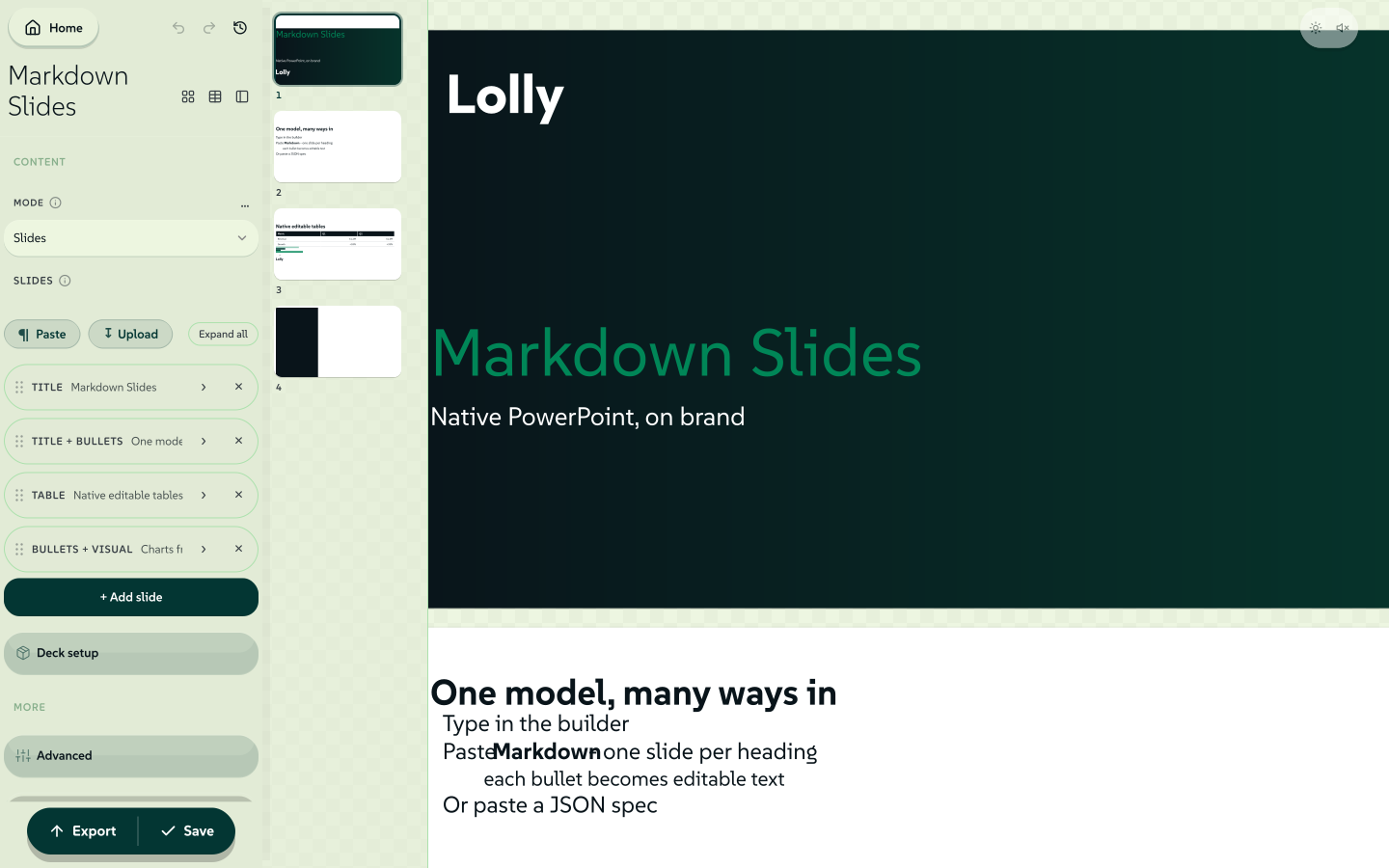
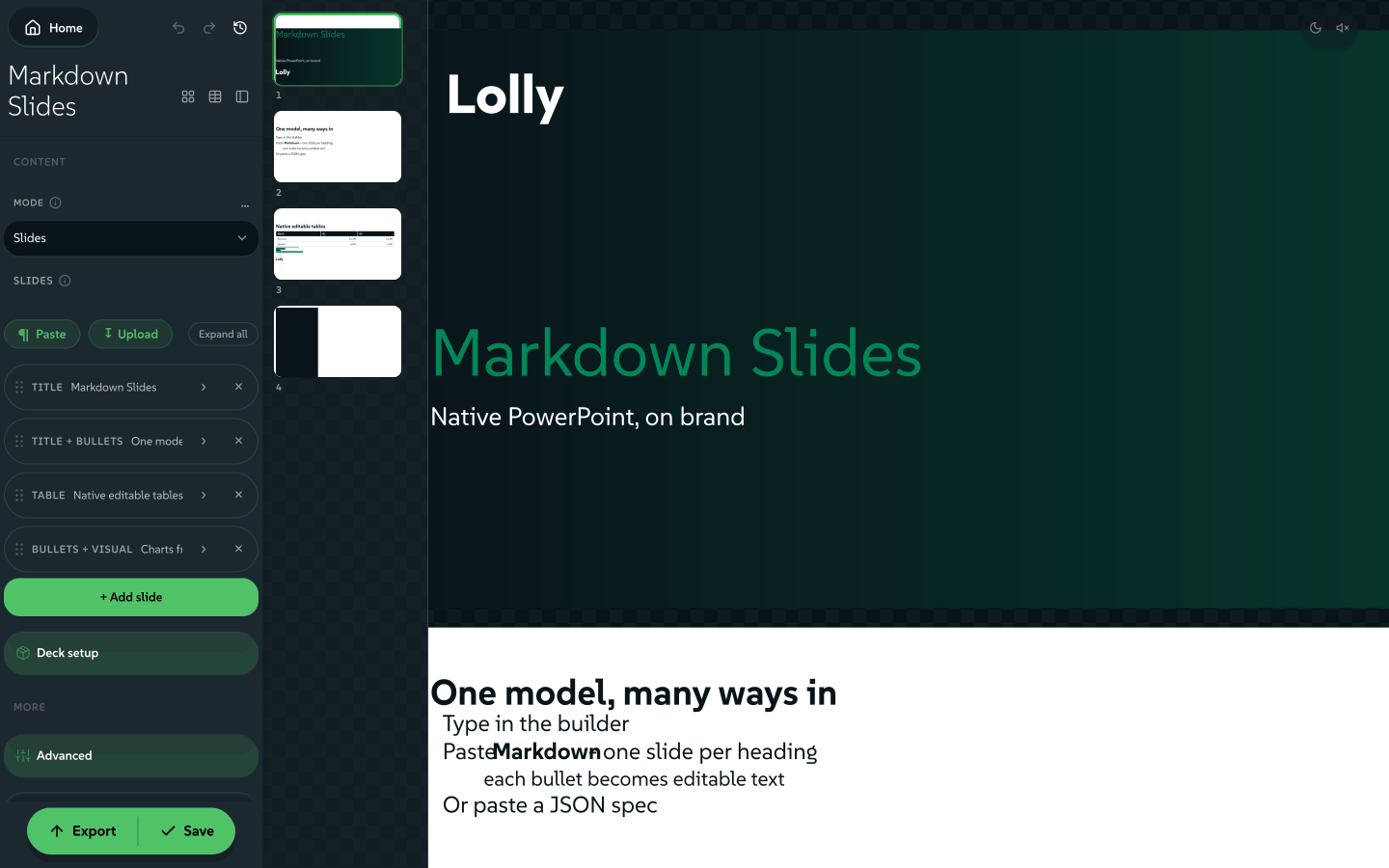
پورا سلائیڈ ڈیک حد دکھاتا ہے: Markdown Slides میں ڈیک ڈیٹا کے طور پر اعلان ہوتا ہے، لائیو لے آؤٹ ہوتا ہے اور مقامی، قابل ترمیم PowerPoint فائل کے طور پر ایکسپورٹ ہوتا ہے۔
 signed by Lollyvector SVG135 paths~17k nodes252 groups1 image226 KBCheck it yourselfدستخط شدہ فائل حاصل کریں
 signed by Lollyvector SVG128 paths~17k nodes252 groups1 image225 KBCheck it yourselfدستخط شدہ فائل حاصل کریں


اصول ٹول میں رہتے ہیں
Lolly دوبارہ قابل استعمال برانڈ اصول ٹول میں رکھتا ہے: رنگ، فونٹس، bleed حاشیے، فاصلہ اور اجازت یافتہ ان پٹس۔ ٹیمپلیٹ وہ حصے مقرر کرتا ہے جنہیں وصول کنندہ نہیں بدل سکتا۔ Lolly Work اس ٹیمپلیٹ کے گرد گروپ رسائی اور ان پٹ پالیسیاں شامل کرتا ہے، کیٹلاگ جمع آوریوں اور ڈیلیوری کے لیے منظوری کی زنجیروں کے ساتھ۔
ٹول کو ایک بار جانچنا دوبارہ قابل تکرار پروڈکشن آسان بناتا ہے، کیونکہ ہر آؤٹ پٹ اپنے لے آؤٹ اصول وراثت میں لیتی ہے۔ متن، اپ لوڈ کی گئی تصویر اور استعمال کے حقوق کو پھر بھی جانچ چاہیے ہو سکتی ہے، اور Lolly Work اس کے لیے مشترکہ کیٹلاگ اور منظوری کے مراحل دیتا ہے۔ تخلیقی ٹیم کے لیے ٹول guard-rail ہے: ڈیٹا، متن اور تصویر آپ لاتے ہیں، اور ٹول ہر نتیجے کو آن برانڈ رکھتا ہے۔
 signed by Lollyvector SVG121 paths~4.6k nodes197 groups2 images113 KBCheck it yourselfدستخط شدہ فائل حاصل کریں

تین اور چیزیں اس طریقے کو الگ کرتی ہیں:
- ان پٹس سے حتمی فائل۔ ان پٹ اندر، مکمل فائل باہر، بغیر "اب اسے اپنے ڈیزائن ٹول سے محفوظ کریں اور ٹھیک کریں"۔
- ٹولز ٹولز کو جوڑتے ہیں۔ ایک ٹول دوسرے ٹول کا رینڈر ایک مکمل فائل میں ایمبیڈ کر سکتا ہے، ان کے درمیان کوڈ کے جوڑ کے بغیر۔
- نیچے تک کھلا۔ انجن اوپن سورس ہے، اور ٹولز، ایسیٹس اور ڈیزائن ٹوکنز فائلیں ہیں جنہیں آپ ورژن کنٹرول میں رکھ سکتے ہیں یا Lolly Work میں منظم کر سکتے ہیں، کسی اور کے ڈیٹا بیس کی قطاریں نہیں۔
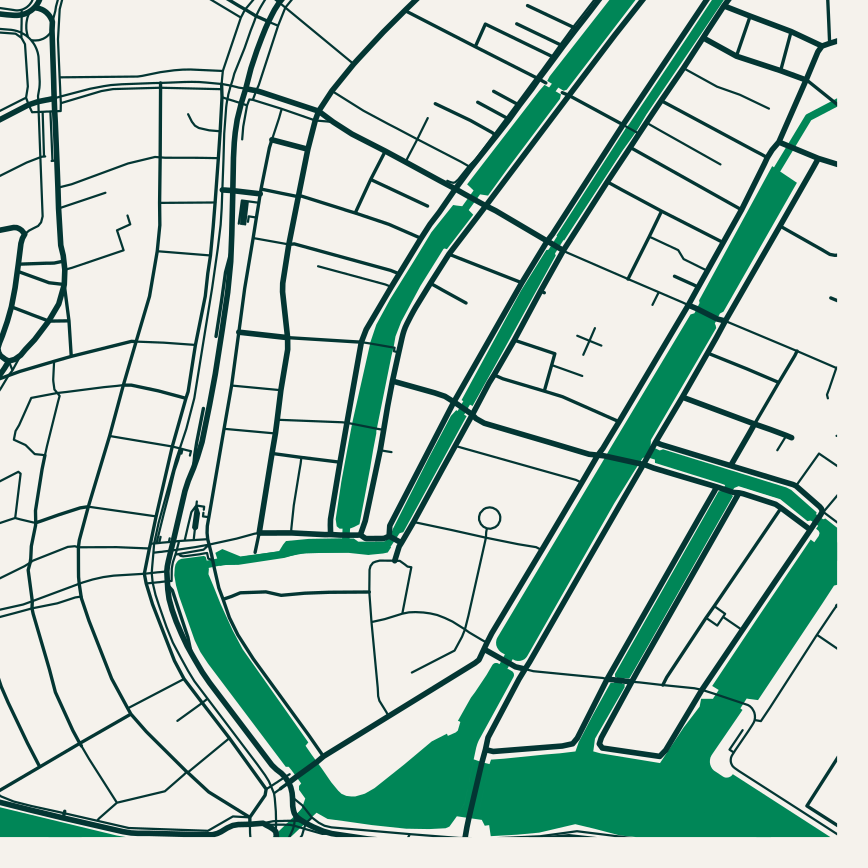
مہم جو ڈیزائن guard-rails سے بچ نکلتا ہے۔ یہ پوسٹر معیار کا شہر کا نقشہ حقیقی ویکٹر سڑک اور پانی کے پاتھس ہے، ایک ڈراپ ڈاؤن اور دو رنگ کے فیلڈز سے جنہیں ڈیزائن سسٹم سے باہر نہیں موڑا جا سکتا:
 signed by Lollyvector SVG8 paths~25k nodes7 groups287 KBCheck it yourselfدستخط شدہ فائل حاصل کریں
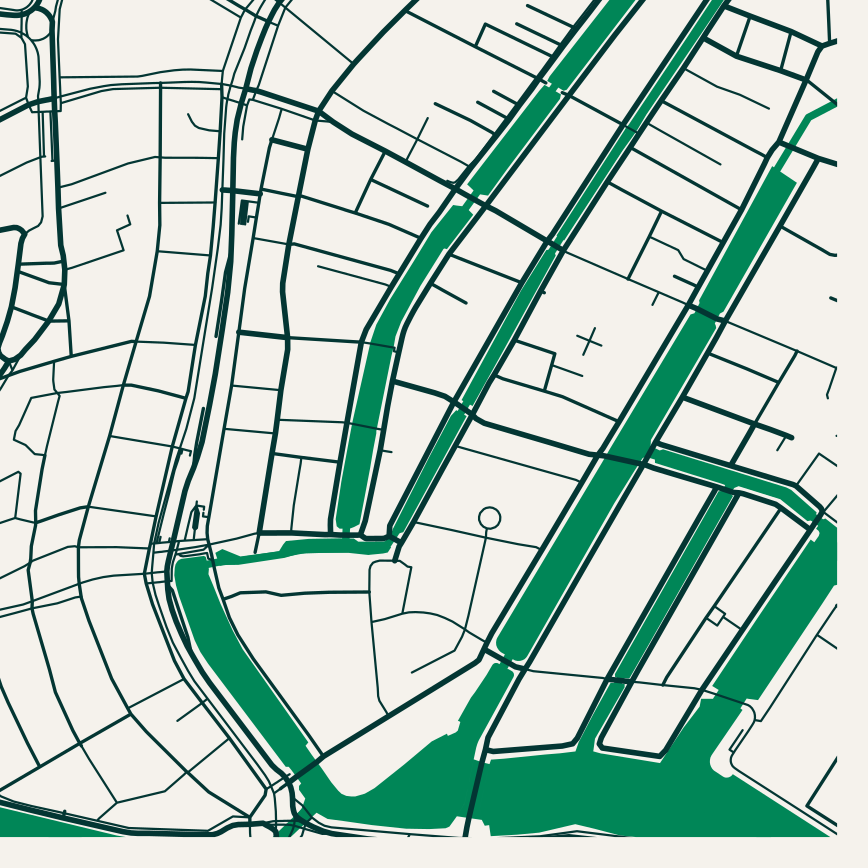 signed by Lollyvector SVG8 paths~25k nodes7 groups287 KBCheck it yourselfدستخط شدہ فائل حاصل کریں


احتمالی طور پر جدت کریں، طے شدہ انداز میں پیمانہ بڑھائیں
زیادہ تر "AI creative" پیشکشیں ماڈل کو ایک پرانی لکیر کی غلط طرف رکھتی ہیں۔ کاتبوں اور مصوروں نے طے کیا تھا کہ وہ کہاں پڑتی ہے۔ آپ خاکے پر کھل کر کام کرتے ہیں، جہاں کچھ بھی آزمایا جا سکتا ہے اور کچھ پکا نہیں ہوتا۔ پھر آپ چھاپہ خانے جاتے ہیں، جو پکا کرتا ہے۔ خاکے وہ جگہ تھے جہاں فن تھا، اور چھاپہ خانہ اس کے سفر کا ذریعہ، اور چھپا کام قابل اعتماد تھا کیونکہ چھاپہ خانہ ہر چھاپ پر اپنا وعدہ نبھاتا تھا۔
Lolly چھاپہ خانہ ہے۔ خیالات کے لیے جو چاہیں لائیں، ماڈل، ڈیزائنر یا کچا خاکہ، لیکن جس لمحے خیال کو بہت سی فائلیں بننا ہو وہ ایسی چیز سے گزرتا ہے جو ہر بار ایک ہی طرح رینڈر کرے، ایسے ان پٹس سے جنہیں کوئی بھی واپس پڑھ سکے۔ اوپر کا موازنہ دراصل اس بارے میں ہے کہ اس پکے قدم کو قابل تکرار کون بناتا ہے۔
تخلیقی عمل پر اعتماد کریں، سختی کے ساتھ پیمانہ بنائیں۔
ہمیشہ کے لیے مفت
اگر یہ آپ کی ڈیوائس پر رینڈر ہوتا ہے تو یہ ہمیشہ کے لیے مفت ہے۔ انجن، شیلز، ٹولز اور فارمیٹس اوپن سورس ہیں، اور جاری کردہ ورژن واپس نہیں لیا جا سکتا۔ Lolly Work بھی اوپن سورس ہے۔ تنظیم اس انفراسٹرکچر اور آپریشن کی قیمت دیتی ہے جو وہ چنتی ہے، self-hosting کے لیے فی سیٹ یا فی رینڈر سافٹ ویئر لائسنس کے بغیر۔ سوالات اور جوابات وعدے کے پیچھے کی کہانی بتاتا ہے۔
آپ کا مواد کہاں رہتا ہے
Lolly کا تخلیقی کام آپ کی ملکیت کے ہارڈ ویئر پر چل سکتا ہے، اور اس کے ڈیزائن ٹوکنز، فونٹس، لوگوز اور ٹولز فائلیں ہیں جنہیں آپ رکھ سکتے ہیں۔ Lolly Work کے ساتھ مشترکہ پروجیکٹس، ایسیٹس، پالیسی اور آڈٹ ریکارڈز اس اسٹوریج میں رہتے ہیں جو آپ کی تنظیم ترتیب دیتی ہے۔ اعتماد بتاتا ہے کہ یہ کیوں اہم ہے، اور رازداری کی پالیسی اور Verify It Yourself آپ کو دعویٰ جانچنے دیتے ہیں بجائے ہماری بات ماننے کے۔
ٹول بہ ٹول
Lolly کا موازنہ، ٹول بہ ٹول Lolly کا موازنہ Canva، Adobe، Figma، Penpot، برانڈ پورٹلز، رینڈرنگ APIs اور آن لائن کنورٹرز سے کرتا ہے، ہر ایک کا ایک صفحہ، اور کیا کہاں چلتا ہے بیان کرتا ہے۔