
This guide covers the optional organisation service. Configuration, console and API paths refer to your Work instance. The packaged console keeps its release-matched copy of this guide.
This is the Lolly control plane - the hosted half of Lolly. It holds identity, provisioning, governance, serving, telemetry and audit for one organization's deploy, and it serves the Lolly web shell, the governed catalog and the admin console from a single origin.
The compass, unchanged since the first plan: open source = individual freedom; open source + a control plane = organizational freedom. Lolly renders on-device by design. Every hosted service lives here.
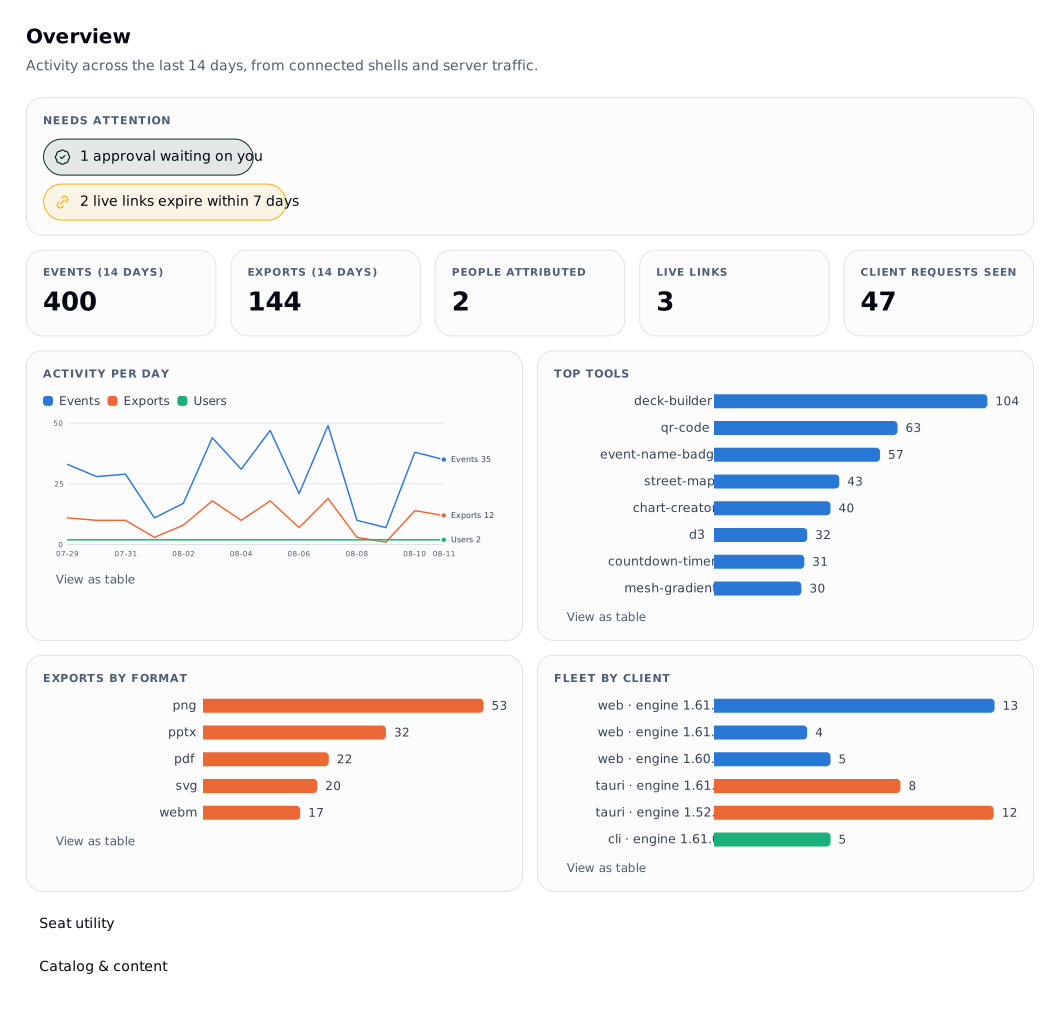 signed by Lolly Demovector SVGتحقق بنفسكاحصل على الملف الموقَّع27 paths197 nodes143 groups189 KB
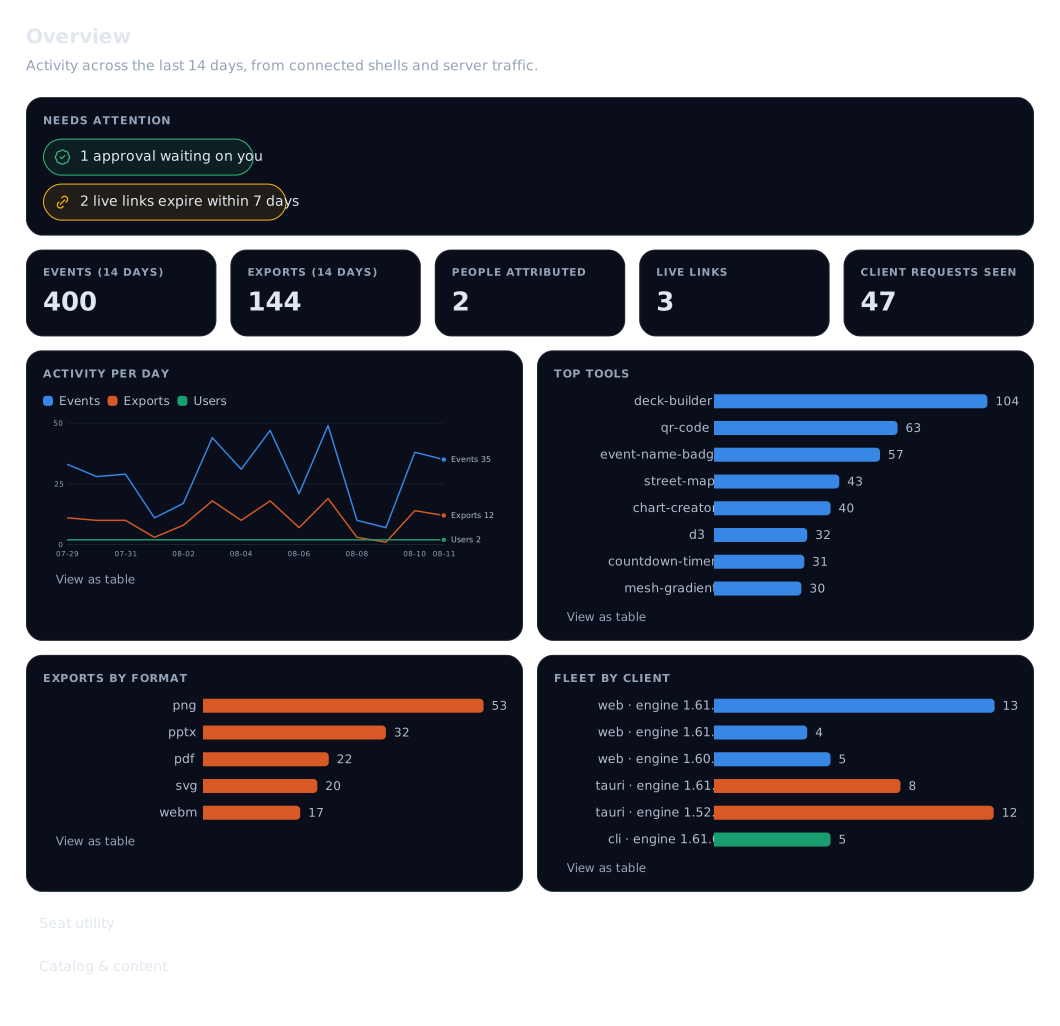 signed by Lolly Demovector SVGتحقق بنفسكاحصل على الملف الموقَّع27 paths197 nodes143 groups189 KB


Every screenshot in these docs is itself a Lolly artifact: the console rendered to a real vector SVG and signed with a C2PA Content Credential by this deployment's own signing identity. Hover the imprint in a shot's corner to read what its file claims, then Check it yourself - the console verifies the exact bytes on your machine. The docs eat the product's own dog food.
Two codebases, one deploy
| Lolly (open source, MPL-2.0) | This control plane (open source, MPL-2.0) | |
|---|---|---|
| What | Engine, tool catalog, shells (web, desktop, mobile, CLI, TUI, extension) | Server, admin console, render worker |
| Docs | /info/ on any Lolly deployment | this set |
| Runs | On the user's device | On your infrastructure |
The open-source side is consumed pinned and unmodified (vendor/@lolly/engine, vendor/@lolly-tools/core, pin recorded in engine-pin.json). Work consumes the engine unmodified. The touchpoints the shells need are additive and dormant by default - a shell with no control plane configured behaves exactly as it does standalone.
What this deploy actually serves
| Surface | Path | Who |
|---|---|---|
| Lolly web shell | / (when instance.shellDir is set) | members, guests on a link |
| Admin console | /admin | signed-in members; each view is action-gated |
| Governed catalog | /catalog/, /api/v1/catalog/ | per access mode and exposure policy |
| Server renders | /render/:spec | export.server holders |
| Signed links | /l/:id | anyone holding the link, until expiry or revocation |
| Org config | /api/v1/org-config | connected shells, polled |
| Health / metrics | /healthz, /metrics | monitoring (metrics is token- or loopback-gated) |
The one document a connected shell polls is /api/v1/org-config: who the user is, which tools they see, which inputs are locked, which profile fields are managed, which feature flags apply. It is pre-filtered for the caller's groups and ETag'd on a policy version, so a quiet poll is a 304.
<a id="the-trust-model-honestly"></a>
The trust model
- Renders happen where the content is trusted. The in-process (jsdom) fast path never runs a tool's
hooks.jsunless you opt in per pack (render.allowHooksInFastPath); hooked and HTML-heavy tools go to the isolated Chromium worker, or are refused with501 HOOKED_TOOL_NEEDS_CHROMIUM. - Policy is enforced server-side, before rendering. A locked input is a
422 INPUT_LOCKED, not a hidden field. - Sessions are stateless, signed, domain-separated tokens. A session token cannot be replayed as a guest token, a link signature or an OAuth state. Member requests resolve the live account: disable or a session-epoch bump revokes its existing tokens, and authorization uses current roles/groups. Tokens also expire at
policy.sessionTtlHours. Revocation is per user; individual-session revocation remains open. See identity. - Telemetry never carries input values, and below
standard(or without consent when attribution is opt-in) it never carries a user id. - The audit log is hash-chained, so edits and truncation are detectable - provided you anchor the head somewhere outside this deploy.
Where to go next
- Getting it running: install, then deployment.
- Turning the knobs: configuration, identity.
- Deciding who can do what: permissions, governance.
- Keeping it alive: operations, audit.